


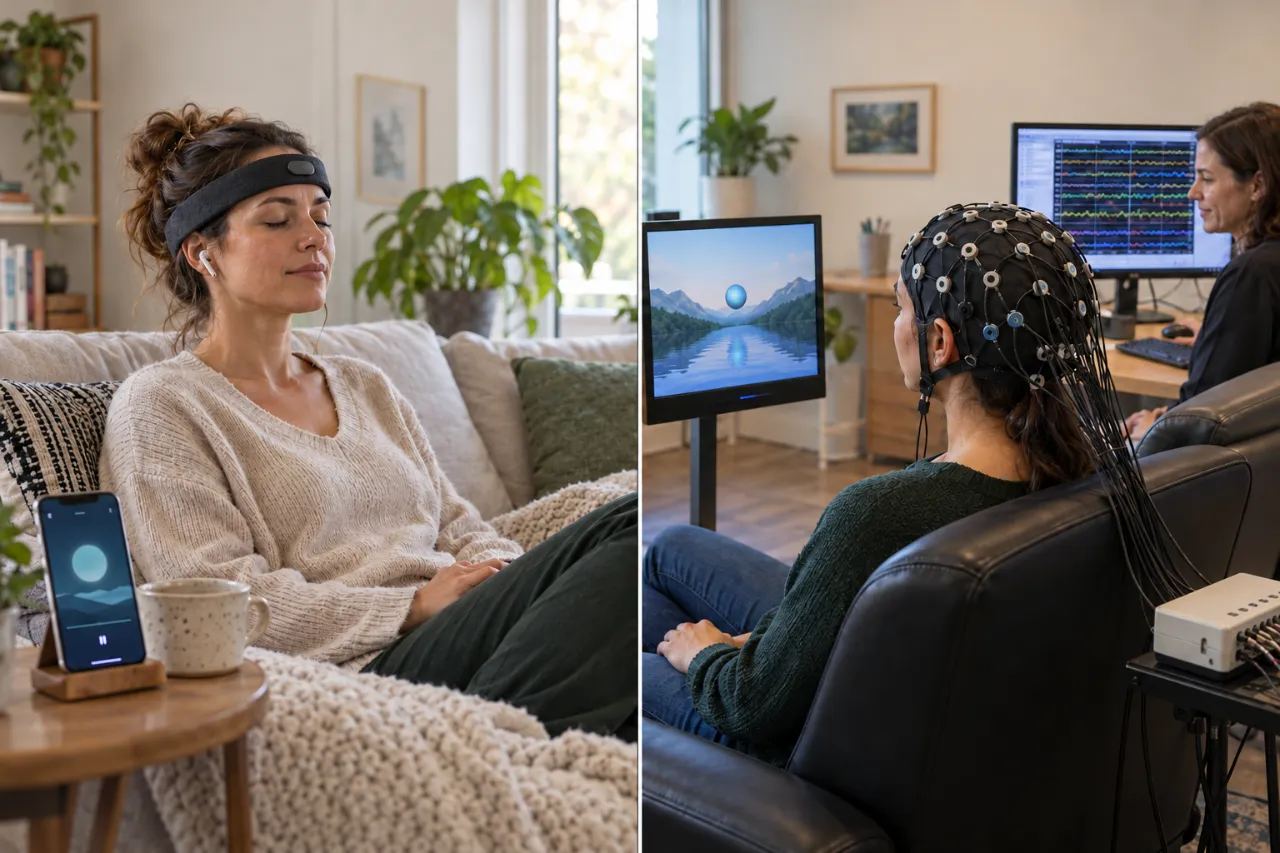
Clinic neurofeedback gives you a trained clinician, a full QEEG brain map and a custom protocol. Home neurofeedback gives you consistency at a fraction of the price.
For most healthy adults chasing better focus, sleep or stress levels, I think the best setup is both: get a QEEG at a clinic once, then do the daily training at home.
That’s what I’ve done. I’ve tested a long list of home neurofeedback devices over the years, and home training has done more for me than I expected. Not because the headsets beat clinic gear. They don’t. It’s because I actually use them.
For me, the Muse S Athena has become an indispensable part of my routine for training my brain for focus and flow. I do 2-3 sessions a week and it has helped me extend my deep work sessions each morning and increase my attention span.
If you’re still deciding whether neurofeedback is worth it at all, start with my guide to the benefits of neurofeedback training, where I grade each claim against the research. This article assumes you’ve decided to try it and want to know where.
Home vs clinic neurofeedback: comparison chart
| Clinic neurofeedback | Home neurofeedback | |
|---|---|---|
| Cost per session | $100 to $200 (USD) | Pennies once you own the device |
| Upfront cost | QEEG brain map, often $300 to $1,000 | Device, roughly $250 to $1,700 |
| Full program | $2,000 to $8,000+ for 20 to 40 sessions | Device price, plus any app or coaching subscription |
| Equipment | Medical-grade EEG, often 19 channels for the QEEG | 1 to 5 sensor consumer headband or headset |
| Assessment | Full QEEG brain map | App baseline, no full brain map |
| Protocol | Custom, set by a clinician | Preset programs, or remote coaching on some devices |
| Supervision | In person, every session | None, or remote check-ins |
| How often | Usually once or twice a week | As often as you want, daily if you like |
| Session length | 30 to 60 minutes plus travel | 10 to 30 minutes, no travel |
| Best for | Diagnosed conditions, brain injury, kids, complex cases | Focus, stress, sleep, meditation, peak performance |
| Biggest weakness | Cost and scheduling | No one checking your protocol |
Clinic prices come from Thervo’s neurofeedback cost guide and biofeedback cost guide while device prices come from my home neurofeedback device guide.
Why I’d still get a QEEG at a clinic
The one thing a clinic does that no headband can is the QEEG. It’s the part of clinic neurofeedback I’d pay for.
A QEEG, or quantitative EEG, is a brain map. A clinician puts a cap with around 19 sensors on your head and records your brainwaves at rest, usually with eyes open and closed. Software then compares your patterns to a database of other brains your age.
What you get back is a picture of where your brain runs too fast, too slow, or out of sync. Maybe you have excess slow theta at the front of your head. Maybe your high beta is running hot, which often shows up as rumination and racing thoughts.
A home headband reads one to five spots on your forehead and behind your ears. It can’t show you that full picture. So without a map, you’re picking a protocol based on how you feel, which is guessing.
The price varies a lot. Thervo puts it at $500 to $1,000 on top of clinic sessions. One Ontario clinic lists a brain map at $335, while a Lake Tahoe practice charges $1,200. Either way, it’s a one-time cost. You don’t need a new map every month.
My advice: get the map, sit down with the clinician, and ask which brainwaves and which spots they’d train. Then take that plan home.
Consistency is where home training wins
Neurofeedback is training. Your brain learns a pattern through repetition, the same way your body learns a squat. So how often you train matters as much as how good the gear is.
At a clinic, you’re probably going in once a week, maybe twice. Each visit means booking a slot, driving there, parking and sitting in a waiting room. A 30-minute session can eat two hours of your day. Miss a week for travel or a busy stretch at work and you lose momentum.
At home, I put the headband on before my morning deep work block. It takes 15 minutes. I don’t have to book anything or leave the house, and I can take it with me when I travel.
That adds up fast. Train at home five days a week for three months and you’ve done about 60 sessions. A weekly clinic plan gets you about 12 in the same time, for thousands more.
The catch is that nobody makes you do it. A clinic appointment is a commitment someone else holds you to. At home, the device ends up in a drawer if you don’t build a habit around it. What worked for me was tying it to something I already do every day, so it stopped being a decision.
The cost difference is huge
A clinic program usually costs thousands. A home setup usually costs hundreds. Here’s what 40 sessions looks like each way, in US dollars.
| Setup | What you pay for | Rough total |
|---|---|---|
| Clinic only | QEEG ($500 to $1,000) + 40 sessions at $100 to $200 | $4,500 to $9,000 |
| Home, budget | Muse headband ($249 to $399) | $249 to $399 |
| Home with remote coach | Muse + Myndlift coaching at $150 a month for 3 months | About $700 to $850 |
| Home, advanced | Sens.ai headset (about $1,700) | About $1,700 |
| Hybrid (my pick) | One clinic QEEG + a home device | About $750 to $2,700 |
The home numbers also keep going after session 40. Once you own the device, session 100 costs the same as session one.
Insurance can change the clinic math. Thervo reports that when insurance covers neurofeedback, it usually pays 20% to 50% of the cost, and many clinics take HSA or FSA cards. Check your plan before you rule a clinic out on price.
Some clinics also rent out home units with remote supervision. Thervo lists those at $150 to $700 a month, which sits between the two options above.
When a clinic is the better choice
I’m a fan of home training, but I wouldn’t DIY everything. Go to a clinic if any of these apply:
- You have a diagnosed condition like ADHD, PTSD, depression or epilepsy and want neurofeedback as part of treatment
- You’ve had a concussion or brain injury
- The training is for a child
- You’ve tried home training for a couple of months and your scores haven’t moved
- You feel worse after sessions, with headaches, anxiety or poor sleep
That last one matters. Training the wrong brainwave at the wrong spot can leave you wired or foggy. A clinician watches for that and adjusts. At home, you have to notice it yourself and stop.
And if you have epilepsy or a seizure disorder, talk to your neurologist before using any home device.
How I’d combine the two
You don’t have to pick a side. Here’s the setup I’d recommend to a friend:
- Book a QEEG brain map at a local clinic. Ask for the report and a feedback session.
- Ask the clinician which brainwaves to train and where. Write down the protocol.
- Pick a home device that can train that protocol. My home neurofeedback device guide compares 10 of them on sensors, price and apps.
- Train at home 4 to 5 days a week, 10 to 30 minutes a session, for at least 8 to 12 weeks.
- Track something outside the app, like sleep, mood or how long you can stay on one task.
- Go back to the clinic for a check-in or a second map if things stall or feel off.
That gets you the clinician’s eyes at the start and the consistency of home training for the long haul, for far less than a full clinic program.
Frequently asked questions
Is home neurofeedback as good as clinic neurofeedback?
Not session for session. Clinic equipment reads more of the brain, and a clinician sets and adjusts your protocol. But home training lets you do far more sessions for less money, and for goals like focus, stress and sleep, that consistency often matters more.
How much does clinic neurofeedback cost compared to home neurofeedback?
Clinic sessions average $100 to $200 each, and a full program of 20 to 40 sessions often runs $2,000 to $8,000 or more. Home devices cost roughly $250 to $1,700 once, with optional subscriptions for coaching.
Do I need a QEEG before home neurofeedback?
No, but it helps. A QEEG shows which brainwaves and which areas need training. Without one, you’re choosing a home protocol based on how you feel.
How often should you do neurofeedback at home?
Most people do 10 to 30 minute sessions, 3 to 5 times a week, for at least 8 to 12 weeks before judging results.
Can a clinic supervise home neurofeedback?
Yes. Many clinics rent home units or use apps like Myndlift to set your protocol and check your data remotely.
Who should choose a clinic over home neurofeedback?
Anyone treating a diagnosed condition, recovering from a brain injury, training a child, or not seeing results at home.

I believe the future of education starts with helping people find their "zone of genius" so they can develop their uniquely human ability to create meaning, connection and community (that A.I. can't replicate).
I'm also big on completely unplugging from tech to recharge on nature retreats and trekking adventures. That led me to start my most recent company Sacred Treks.
- 10 Innovative New Biohacking Wearables I’m Excited For In 2027 - November 9, 2026
- Neurable One Review: Can These EEG Headphones Help You Reclaim Your Focus? - November 9, 2026
- 40 Best Health & Wellness Conferences Happening In 2026/2027 - November 8, 2026