



A workshop funnel is a simple way to get clients: you run ads or outreach to a live online workshop, give people a real win in the session, then invite them to work with you at the end.
That’s the whole model. Ad, registration page, live workshop, offer, follow-up.
I’ve helped hundreds of people launch paid workshops, and I’ve spent millions of dollars on Meta and Google ads for clients and my own businesses. The workshop funnel is the one I come back to. It works in crowded niches, it doesn’t need you to post on social media every day, and it sells high ticket offers without feeling like a pushy pitch.
This guide covers why workshops work so well right now, how to fill one, the four-quarter structure I use to run them and how to sell your offer at the end.
The problem: a trust apocalypse
Getting clients online is harder than it was five years ago. Not because people stopped buying, but because they stopped believing what they see.
I call it the trust apocalypse, which was a term coined by cognitive scientist and philosopher John Vervaeke because four things are happening at once that are undermining people’s trust in each other and particularly in the experts who offer advice to others.
1. Content is everywhere and most of it is noise
AI-made content is free to produce. Graphite’s analysis of Common Crawl data found that roughly half of new online articles are now primarily AI-generated. Your audience scrolls past thousands of posts, reels and blog articles a week. Another post from you is one more drop in a flood.
2. Every niche is crowded
Five years ago you could be “the business coach for therapists” and stand out. Now there are dozens of them, all running similar ads with similar promises. When everyone sounds the same, buyers can’t tell who is good, so they don’t buy from anyone.
3. People trust strangers less
The 2026 Edelman Trust Barometer found that 70% of people are unwilling or hesitant to trust someone whose values or background differ from theirs. People are retreating into small circles of people they already know. A cold ad from someone they’ve never met starts at a disadvantage.
4. Social media is a treadmill
The standard advice is to post every day, on every platform, forever. Most solo coaches and consultants burn out on it. Organic reach keeps shrinking, and the content you made last month is already buried.
You can’t out-post this problem. You need a format that builds trust fast, with real people, in real time. That is what a workshop does.
Why workshops break through the noise
A workshop is the opposite of a feed. It’s live, it’s human and it asks people to do something. Here is why that works so well right now.
1. People get to know, like and trust you in one sitting
Most marketing tries to build trust slowly, one post at a time, over months. A 90-minute workshop does it in an afternoon.
Attendees see your face, hear how you think, ask you questions and watch you coach someone live. By the end, you’re not a stranger with an ad. You’re the person who helped them get unstuck today.
2. Live is the one thing AI can’t fake
When anyone can generate a polished article or video, the things that can’t be faked become worth more. A live room where you answer real questions in real time is one of them. People are hungry for live experiences because so much of what they see online feels manufactured.
3. You can run ads straight to it and skip the posting treadmill
You don’t need a big following to fill a workshop. You need a clear promise, a registration page and an ad budget. That means you can spend your time running great workshops and serving clients, not filming content every day.
4. Every workshop builds your email list
Everyone who registers gives you their email, whether they show up or not. That list is yours. It doesn’t depend on an algorithm, and you can invite those people to your next workshop, your next offer or your next event.
5. The sale feels natural
In a workshop, people get a small win first. Then you invite them to get the big win with you. Selling becomes an invitation to keep going, not a pitch to a stranger.
Also, the skills that make a good workshop host (holding a room, guiding exercises, reading the energy, making an offer) are the same skills you need to run retreats and masterminds. More on that near the end of this guide.
How the workshop funnel works
The workshop funnel has seven stages. Each one has one job: move the right people to the next stage.
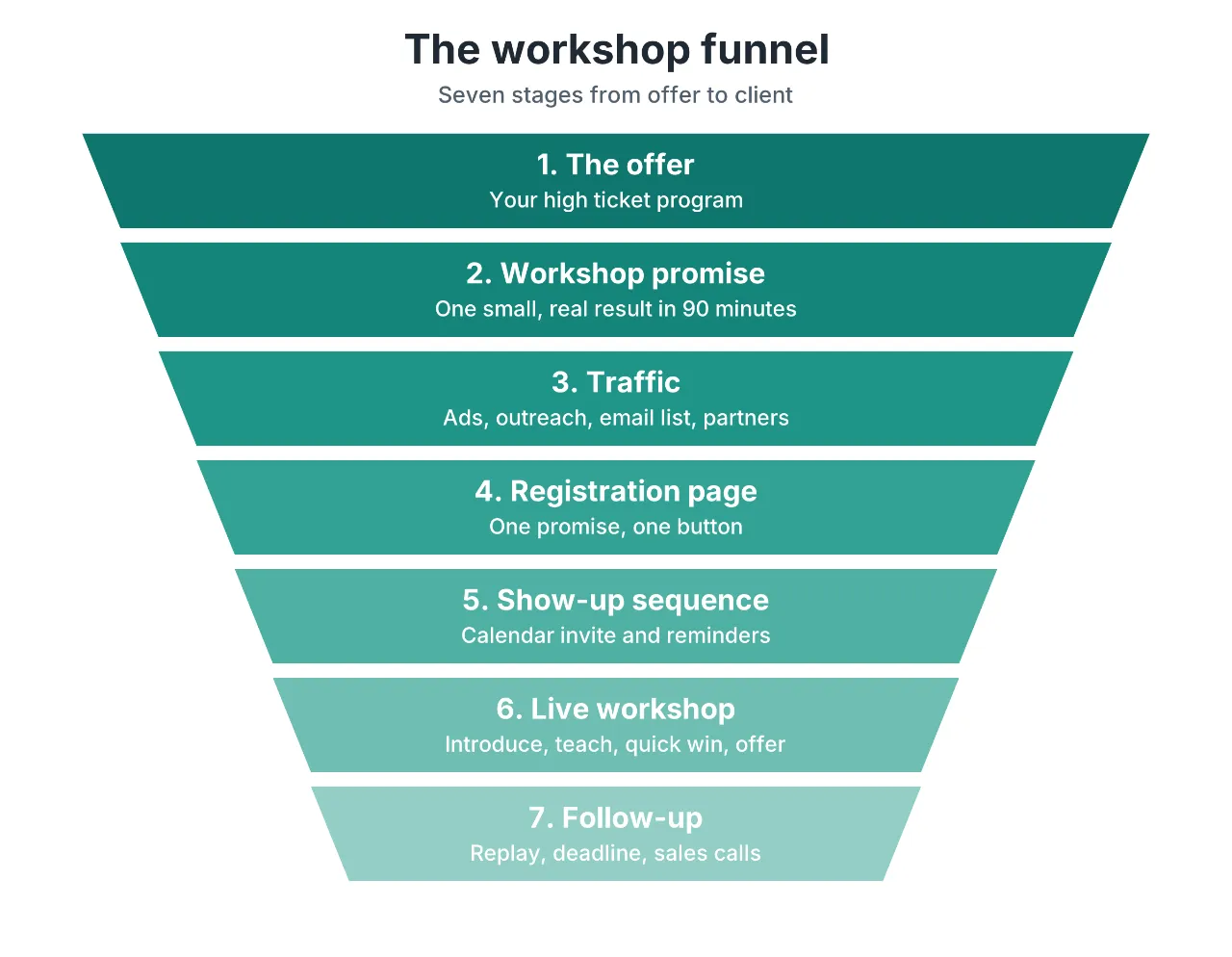
- The offer. Start at the end. Decide what you’ll sell: a coaching program, consulting package, group program or mastermind. The workshop exists to sell this.
- The workshop promise. Pick one small, real result someone can get in 90 minutes that is a first step toward your offer. “Write your signature offer on one page” or “build your 7-day meal plan” beats “learn about nutrition.”
- Traffic. Run ads, do outreach, email your list and partner with others to get people to the registration page.
- Registration page. One page, one promise, one button. Date, time, what they’ll walk away with, who you are and a short form.
- Show-up sequence. A confirmation email with a calendar invite, then reminders the day before, one hour before and at start time. A text reminder helps too.
- The live workshop. Run it with the four-quarter structure below: introduce, teach, give a quick win, then make the offer.
- Follow-up. Send the replay, the workbook and the offer with a clear deadline. Book sales calls with everyone who raised their hand.
The whole funnel can be live in a week. You don’t need a fancy tech stack: a page builder, an email tool, Zoom and a way to take payments is enough.
How to fill an online workshop
There are many ways to fill an online workshop. Ads are usually the most effective because they’re predictable and you can turn them up or down. But they only work if you know your numbers first.
Know your money math before you spend a dollar
Your money math tells you how much you can afford to pay for each registration and still make a profit. You need four numbers:
- Offer price: what your high ticket offer costs.
- Show-up rate: the share of registrants who attend live.
- Close rate: the share of attendees who buy.
- Cost per registration: what you pay in ads to get one sign-up.
The formula for your break-even cost per registration:
Break-even cost per registration = offer price × show-up rate × close rate
Here’s an example with round numbers. Use your own once you have them.
| Number | Example |
|---|---|
| Offer price | $5,000 |
| Registrations | 200 |
| Cost per registration | $10 |
| Ad spend | $2,000 |
| Show-up rate | 35% (70 attendees) |
| Close rate | 5% of attendees (3 clients, rounded down) |
| Revenue | $15,000 |
| Break-even cost per registration | $87.50 |
In this example, you could pay up to $87.50 per registration and still break even on the first sale. That gives you a lot of room to test ads.
If you don’t have numbers yet, run your first workshop small. Even 20 to 30 attendees will tell you your real show-up and close rates.
Filling with paid ads
Meta ads (Facebook and Instagram) are the workhorse for most workshops because the targeting is broad and registrations are cheap. Google and YouTube ads work well when people already search for your solution.
What makes a workshop ad work:
- One clear promise: the result they’ll walk away with.
- A date and time. Live events create urgency that evergreen content doesn’t.
- Your face. People are signing up to spend time with a person.
- A simple video or image of you talking straight to camera about the problem.
Start with a small daily budget, find the ad with the lowest cost per registration, then scale that one.
Charging for the workshop
A low ticket price, often $27 to $97, does two things. It raises the show-up rate, because people value what they pay for. And it pays back part of your ad spend before you make a single high ticket sale. Some workshops pay for all their ads this way.
Filling with outreach
Outreach is free and works well for your first few workshops:
- Personal messages to people who already follow or know you.
- Your past clients, who can invite a friend.
- Communities you’re part of, where hosts allow event posts.
- Your email list, even an old one.
Keep messages personal and short: who it’s for, what they’ll get and a link.
Other ways to fill a workshop
- Partnerships. Co-host with someone who serves the same audience and share the sales.
- Podcasts. Invite listeners to your next workshop at the end of an interview.
- Your own community. A free group on Skool or similar is a natural place to announce workshops.
- Repeat attendees. People who came once will come again if you teach something new.
Most people combine two or three of these. Ads give you scale, and outreach and partners lower your average cost.
How to run it with the four-quarter workshop structure
I split every workshop into four equal quarters. For a 2-hour workshop, each quarter is about 30 minutes. For a 90-minute workshop, each quarter is about 20 minutes, leaving time for some questions.
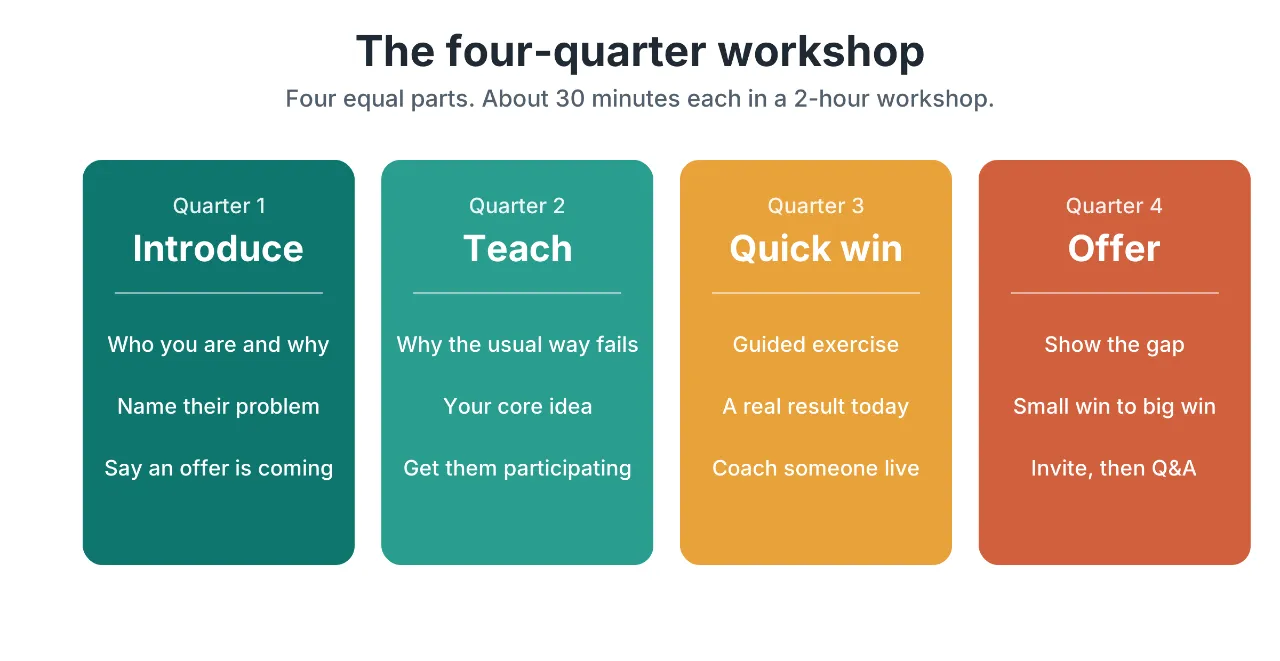
Quarter 1: Introduce yourself and the problem
Welcome people, tell them who you are and why you do this work. Then name the problem they’re facing, in their words. If they nod along, you’ve earned the next hour.
This is also where you tell them there’s an offer coming. Say it plainly: “At the end, I’ll share how you can work with me. If you’re not interested, feel free to leave then. No hard feelings.”
That one sentence does a lot. People relax because there’s no surprise pitch. And the ones who stay to the end chose to hear it.
Quarter 2: Go deeper and teach
Teach the core idea behind your method. Why the usual approach fails, what actually works and the first step. Keep it practical and specific.
Get people participating early: ask them to answer in the chat, fill in a worksheet or share in a breakout room.
Quarter 3: Deliver the quick win
This is the heart of the workshop. Guide everyone through an exercise that gets them a real result before they leave.
The quick win depends on your niche:
- Business: their offer written on one page, or their first outreach message.
- Health: a 7-day meal plan, or their morning routine mapped out.
- Relationships: the one conversation they need to have, scripted.
- Life: their top goal for the next 90 days, broken into weekly steps.
Ask a few people to share what they made, and coach one or two of them live. This is where the room sees what working with you feels like.
Quarter 4: Make the offer
Now you sell, openly and without pressure. The next section covers exactly how.
How to sell at the end of a workshop
The offer is the bridge from the small win they got today to the big win they came for. Make that bridge obvious and the sale takes care of itself.
Show the gap
Start by pointing at what they just did. “An hour ago you didn’t have an offer. Now it’s on one page. That’s step one.” Then show the rest of the path: the steps between today’s small win and the full result, whether that’s a business that pays the bills, a body they feel good in or a relationship that works.
Most people can’t walk that path alone, or they’d have done it already. That’s where you come in.
Present the offer simply
- Who it’s for, and who it’s not for.
- What they get: sessions, support, tools, community.
- The result you’ll work toward together.
- The price, said out loud.
- The next step: book a call, apply, or buy now.
For high ticket offers, the next step is usually a call. It lets you check fit, answer questions and make sure you only take people you can help.
Be transparent the whole way
You told them in quarter 1 that an offer was coming. Keep that promise: no fake scarcity, no countdown timers that reset, no pretending a replay is live. If there’s a bonus for acting by a deadline, make the deadline real.
Transparency is your edge in a low-trust market. People notice when you treat them like adults.
Take questions
Leave 10 to 15 minutes for questions after the offer. Answer honestly, including “this isn’t right for you” when it’s true. The people still asking questions at minute 110 are your best buyers.
After the workshop: follow-up that closes
Many sales happen after the workshop, not during it. People need to talk to a partner, check their calendar or sleep on it. A simple follow-up sequence catches them.
- Same day: send the replay, the workbook and the link to book a call or join.
- Day 1: share a story or result from a past client who started where they are.
- Day 2: answer the most common questions from the live session.
- Day 3: a final reminder that the bonus or the price ends at the deadline.
Send the same sequence to people who registered but didn’t attend. Some of them will watch the replay and buy.
On your sales calls, start with what they did in the workshop. They already know you, they’ve already had a win, and the call is about whether to keep going together.
After each workshop, write down your numbers: registrations, cost per registration, show-up rate, calls booked and sales. Two or three workshops in, your money math stops being a guess.
From workshops to retreats and masterminds
Workshops are a training ground. Once you can run a good one, you can run bigger, higher-value events.
The skills carry straight over:
- Holding a room and keeping energy up.
- Designing exercises that get people a result.
- Handling questions, quiet attendees and loud ones.
- Making a clear, honest offer.
A natural path looks like this. A 90-minute workshop leads to a multi-day workshop. Workshop buyers join a group program or mastermind. Mastermind members come to an in-person retreat.
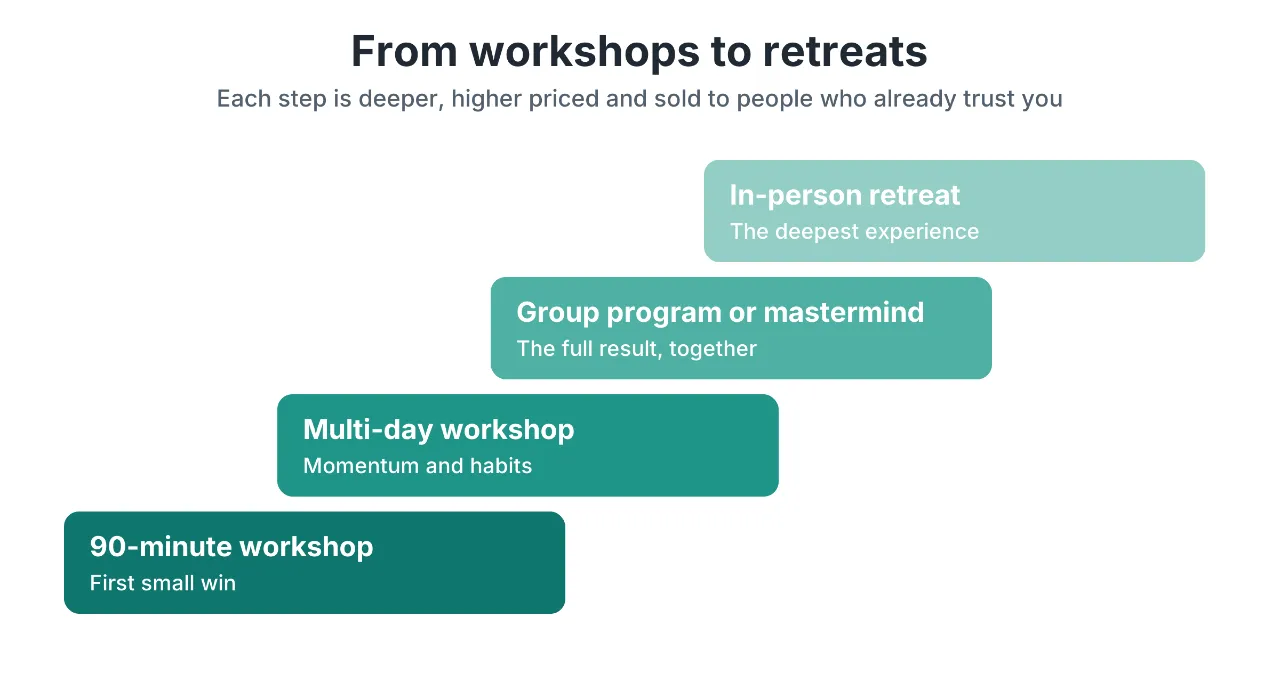
Each step is a deeper experience at a higher price, sold to people who already trust you from the step before. Your workshop attendees become your mastermind members, and your mastermind members become your retreat guests.
I’ve led nature retreats and hiking trips since 2016. The same principles apply whether you’re on Zoom or on a mountain: give people a real experience, make them feel safe and seen, then invite them further.
The Workshop Funnel FAQ:
What is a workshop funnel?
A workshop funnel is a marketing system where you drive people to a live online workshop, give them a real result in the session and invite them to buy a higher-priced offer at the end.
How is a workshop funnel different from a webinar funnel?
A webinar is a presentation where the audience watches. A workshop is a working session where attendees do exercises and get a result. Workshops usually convert better for high ticket offers because people experience your coaching before they buy.
How long should a sales workshop be?
90 minutes to 2 hours works for most. Split it into four equal quarters: introduction, teaching, quick win and offer.
Should I charge for my workshop?
A low price ($27 to $97) usually raises show-up and attracts more serious buyers. It can also pay back part of your ad spend. Free workshops get more sign-ups but more no-shows.
How many people do I need for a workshop?
You can run a good workshop with 10 people. Past about 50 active participants, it gets hard to keep everyone involved.
What’s the best way to fill a workshop?
Paid ads are usually the most effective and predictable, once you know your money math. Outreach, your email list, partnerships and podcasts are good free ways to fill your first few.
Do I need a big social media following?
No. Ads and outreach can fill a workshop without a following. Every workshop also grows your email list, so each one gets easier to fill.
I believe the future of education starts with helping people find their "zone of genius" so they can develop their uniquely human ability to create meaning, connection and community (that A.I. can't replicate).
I'm also big on completely unplugging from tech to recharge on nature retreats and trekking adventures. That led me to start my most recent company Sacred Treks.
- 10 Innovative New Biohacking Wearables I’m Excited For In 2027 - November 9, 2026
- Neurable One Review: Can These EEG Headphones Help You Reclaim Your Focus? - November 9, 2026
- 40 Best Health & Wellness Conferences Happening In 2026/2027 - November 8, 2026