


We are witnessing a fundamental transformation in how humans learn and grow. For centuries, education has been built on the transmission of information through lectures, textbooks, videos, and articles.
The assumption was simple. If you give people knowledge, they will apply it. But that assumption is crumbling.
We do not learn by consuming information. We learn by living through experiences that reshape how we see the world and ourselves.
The experience economy has arrived, and it is revolutionizing learning. Today’s learners do not want more content. They want more connection.
They do not want to be told what to do. They want to feel what it is like to do it.
This is not a preference. It is a neurological reality. The brain encodes experiences differently than facts.
Consider the difference between reading about mindfulness and spending a week in silent meditation in the mountains. Between studying entrepreneurship and launching a real business with mentors guiding you through the chaos.
The first approach delivers information. The second delivers transformation.
This shift is accelerating because information has become free and abundant. Anyone with an internet connection can access the world’s knowledge. Anyone with ChatGPT can create a personalized plan to achieve their goals.
The scarcity has moved from access to application. The experience economy thrives on this new reality.
Attention has become the most valuable currency. People will no longer want to invest their limited attention in passive consumption, they want a guided path to transformational experience.
They demand engagement, participation, and emotional resonance. Isolation has become a crisis of modern life. Experiences that connect us to ourselves, to others, to place have become essential.
The leaders and social entrepreneurs of the future understand this deeply. Their role is not to be the smartest person in the room with the most knowledge.
Their role is to architect experiences that unlock wisdom in others. They are designers of environments, curators of journeys, facilitators of breakthroughs.
This is why retreats, workshops, immersions, and experiential programs are exploding in popularity. They are not a luxury. They are the new baseline for meaningful learning.
A weekend workshop can catalyze more change than a semester of online courses. A week-long retreat can shift a life trajectory more than years of self-help reading.
The experience economy rewards those who understand that learning is not something you get. It is something you go through.
Key Takeaways:
- Information is abundant. Transformation is scarce.
- The experience economy is revolutionizing how we learn.
- Leaders must become experience architects, not content creators.
- Immersive learning delivers faster, deeper, more lasting change.
Why Experiential Learning Matters Now More Than Ever
We are living through a credentialing crisis. Traditional markers of expertise, degrees, certificates, course completions, are losing their value.
AI can now pass bar exams, write code, diagnose diseases, and generate content that rivals human experts. If a machine can learn the information, what value does human knowledge retention have?
The answer is experience. AI cannot replicate lived experience. It cannot navigate the messy reality of human interaction, emotional complexity, and real-world problem-solving.
In the experience economy, your value is not what you know. It is what you can do with what you know in real contexts with real people facing real challenges.
This is why experiential learning matters now more than ever. It is the only form of learning that builds genuine capability and competence.
You cannot fake experience. You cannot ChatGPT your way through a difficult conversation with a client. You cannot prompt-engineer your way through leading a team through crisis.
These capabilities are built through practice, through failure, through feedback, through iteration. Through experience.
The future belongs to those who can demonstrate their expertise through portfolios, not credentials. Through contributions to communities, not certificates on walls.
Through transformations they have facilitated, not courses they have completed.
The experience economy is creating a new hierarchy of value. At the bottom is information, easily accessible and increasingly automated.
In the middle is knowledge, the ability to synthesize and apply information. At the top is wisdom, the ability to navigate complexity, ambiguity, and human dynamics.
We will live in a world flooded with information but starved for wisdom. Wisdom cannot be taught. It can only be earned through experience.
This is why businesses built on experiential learning are not thriving because they offer something AI cannot replicate: human connection, embodied practice, real-time feedback, emotional breakthroughs, and community support.
They offer the messy, beautiful, irreplaceable experience of learning alongside other humans in contexts that matter.
The experience economy is not a trend. It is the future of how humans will learn, grow, and demonstrate their value in an AI-augmented world.
Why Experience Matters Now:
- AI can replicate information, but not lived experience.
- Credentials are losing value. Portfolios and contributions are gaining it.
- Capability and competence are built through practice, not consumption.
- Wisdom cannot be taught. It must be earned through experience.
- The experience economy offers what AI cannot replicate: human transformation.
The Neuroscience of Experiential Learning

The human brain is not designed to learn through passive information consumption. It evolved to learn by doing.
When we experience something directly, multiple brain systems activate simultaneously. Sensory processing, emotional regulation, memory formation, social cognition, and executive function.
This integrated activation creates neural pathways that are stronger and more durable than those formed through passive learning.
Neuroplasticity, the brain’s ability to rewire itself, is experience-dependent. New neural connections form not when we hear about something, but when we encounter it in a context that matters to us.
This is why a single transformative experience can shift beliefs and behaviors that years of intellectual understanding could not touch.
The emotional charge of an experience acts as a neurochemical marker, signalling to the brain that this is important. Remember this. Use this.
Without that marker, information is processed and discarded.
The hippocampus is particularly responsive to experiences that are novel, emotionally significant, and multi-sensory as I’ve documented in the 7 principles of accelerated learning.
A lecture engages primarily the auditory cortex. An immersive experience in the experience economy engages sight, sound, touch, smell, movement, social connection, and emotion all simultaneously.
This multisensory engagement creates what neuroscientists call rich encoding. Memories that are detailed, contextual, and easily retrievable.
This is why you might forget a book you read last year but vividly remember a moment of insight from a retreat five years ago.
Mirror neurons fire both when we perform an action and when we observe someone else performing it. In experiential learning environments, we do not just observe. We participate, we practice, we embody.
When we see a facilitator model vulnerability, and then practice vulnerability ourselves in a safe container, we are not just understanding the concept intellectually.
We are wiring it into our behavioral repertoire.
The default mode network, active during rest and self-reflection, plays a crucial role in integrating experiences.
This is why the integration periods in experiential programs, reflection time, journaling, sharing circles, are not optional add-ons. They are neurologically essential.
Finally, the social brain cannot be ignored. We evolved to learn in tribes, not isolation. Oxytocin, dopamine, and serotonin are released during meaningful social experiences. Learning in community does not just make the process more enjoyable. It makes it more effective.
Shared experiences create shared meaning, and shared meaning creates shared commitment to change. This is the foundation of the experience economy.
Neurological Principles:
- Rich encoding: Multisensory input creates stronger memories.
- Emotional marking: Feelings signal importance to the brain.
- Mirror neuron activation: Doing, not just watching, wires behavior.
- Integration time: Reflection is neurologically essential.
- Social learning: Community amplifies results.
The New Role of Teachers, Coaches and Creators
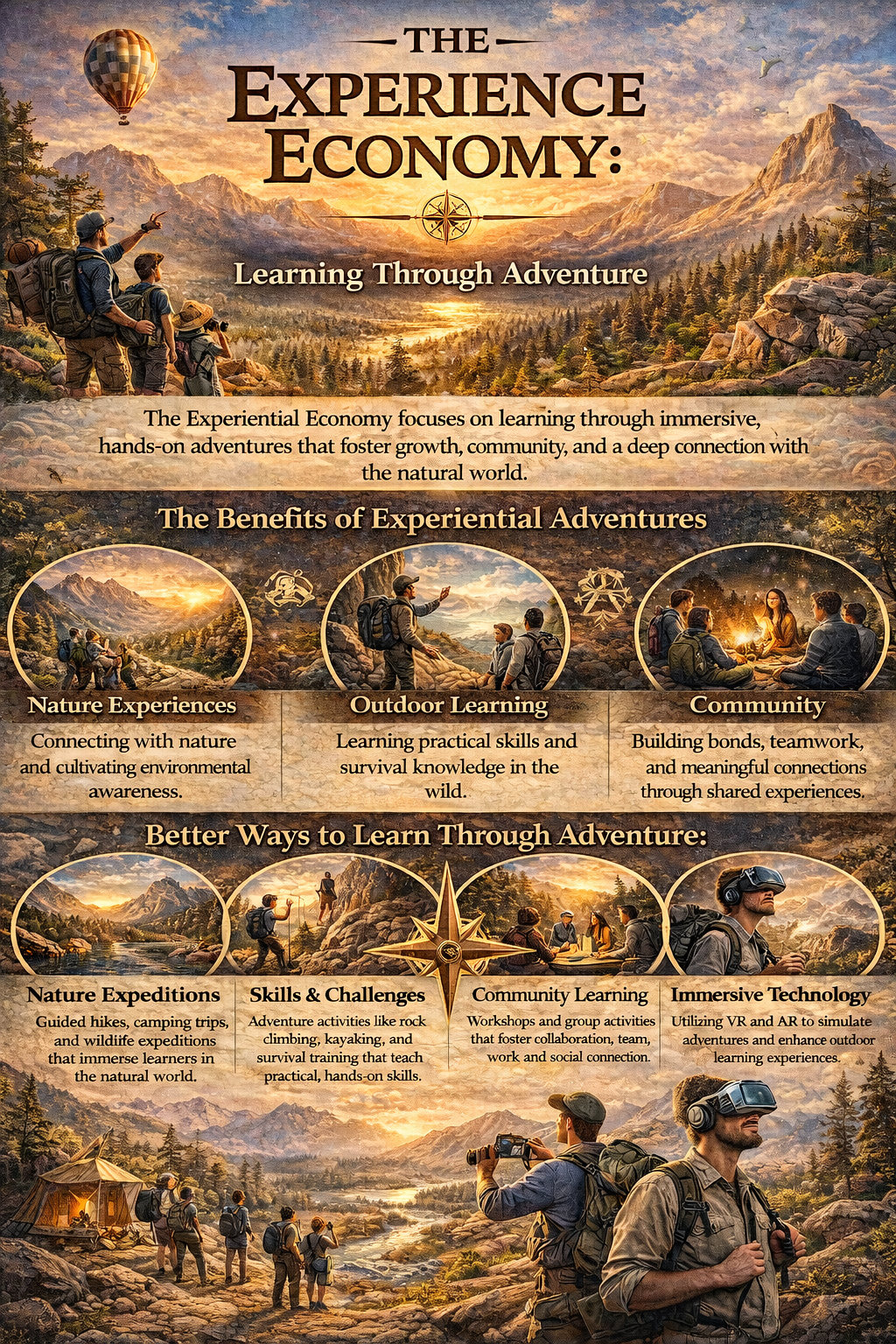
The teacher of the future is not a lecturer and broadcaster of knowledge. The internet already does that perfectly well, for free, at scale.
The teacher of the future is an experience architect. Someone who designs environments, sequences journeys, and holds containers for transformation.
In the experience economy, content expertise is still valuable, but it is no longer the primary differentiator. What matters now is context expertise.
The ability to create the right conditions for the right people at the right time.
A facilitator might know less about a topic than some participants in the room, but if they can create an environment where those participants can learn from each other and from their own inner wisdom, they have delivered more value than any lecture could.
The shift is from having the answers to helping others find theirs.
This new role requires mastery of experiential choreography. Every element of a learning experience must be intentional.
The physical space, the sequence of activities, the balance of intensity and integration, the use of music, movement, silence, and ritual.
Great experience designers think like filmmakers or theater directors. They understand pacing, arc, tension, and release.
The creator economy is evolving into the experience economy. The most successful creators will not be those with the biggest audiences.
They will be those who can translate their expertise into immersive journeys that create real transformation.
A YouTuber with a million viewers who teaches productivity tips is valuable. A creator who runs a 5-day immersive retreat where participants redesign their relationship with time is irreplaceable.
The first scales reach. The second scales impact.
This shift creates new business models. Instead of monetizing through ads or digital courses, creators can monetize through premium experiences that command premium prices.
A $50 online course has competition at every price point, including free. A $3,000 retreat that changes lives has no direct substitute.
The experience economy operates on different economics. Higher price points, lower volume, deeper relationships, more lifetime value.
The new teacher-creator must also become a community builder. Experiences do not exist in isolation. They exist within ecosystems of ongoing relationship.
The retreat or workshop is not the product. It is the gateway to the product.
The real value is the community that forms, the ongoing support, the alumni network, the ripple effects as participants create change in their own contexts.
Perhaps most importantly, this new role demands a different relationship to ego. Traditional teaching positions the teacher as the authority.
Experiential facilitation positions the teacher as the servant, the container, the midwife.
The wisdom is in the room, not at the front. The transformation comes through the experience, not from the teacher.
The New Teacher-Creator Skill Set:
- Experience design: Sequencing, pacing, environmental curation.
- Group facilitation: Reading energy, holding space, navigating dynamics.
- Emotional intelligence: Empathy, attunement, psychological safety.
- Community building: Fostering ongoing connection and support.
- Ego surrender: Facilitating transformation, not delivering it.
Designing Transformative Experiences
Great experiential learning does not happen by accident. It is designed. The experience economy rewards those who master the principles of transformation.
The first principle is intentionality. Every element must serve the learning objectives. Nothing is filler.
The second principle is sequencing. Human transformation follows an arc. Separation, leaving ordinary life. Initiation, entering the experience, facing challenges. Return, integrating insights back into daily life.
Within this macro-arc are micro-arcs for each day, each session, each activity. Build tension, create breakthrough, allow integration. Repeat.
The third principle is threshold crossing. Transformation requires crossing a boundary. Between familiar and unfamiliar, between old identity and new possibility.
Great experiences create explicit threshold moments. A ritual arrival, a symbolic letting-go, a commitment ceremony.
These markers signal to the psyche that something significant is happening.
The fourth principle is somatic engagement. Learning that stays in the mind rarely changes behavior. Learning that enters the body does.
Effective experiences in the experience economy incorporate movement, breath, sensation, and physical practice.
The body is engaged as a learning partner. Breathwork, time in nature, embodied meditation, physical challenges.
The fifth principle is community as curriculum. In transformative experiences, participants learn as much from each other as from the facilitator.
The group becomes a living laboratory. Mirroring back blind spots, offering diverse perspectives, creating accountability.
Great experience designers design group processes that unlock the collective wisdom in the room.
The sixth principle is integration design. Most experiential programs fail not in the experience itself, but in what comes after.
Insights fade without practice. Commitments dissolve without support. Transformation requires integration.
This might include integration calls, accountability partnerships, implementation plans, journaling practices, or community platforms.
The experience is the spark. Integration is the fuel that keeps the fire burning.
The seventh principle is environment as teacher. Where an experience happens matters as much as what happens.
Nature, architecture, light, sound, smell. All of these shape the psychological state of participants.
The environment should reinforce the learning objectives, not work against them.
The eighth principle is the edge of comfort. Transformation happens at the boundary of the known and the unknown.
The sweet spot is optimal anxiety. Enough challenge to activate focus and engagement, enough safety to allow vulnerability and learning.
Experience Design Principles:
- Intentionality: Every element serves the transformation.
- Sequencing: Honor the arc of the journey.
- Threshold moments: Mark the boundaries.
- Somatic engagement: Involve the body.
- Community as curriculum: Unlock collective wisdom.
- Integration design: Translate insights into action.
- Environment as teacher: Design the space intentionally.
- Edge of comfort: Calibrate optimal challenge.
The Business of the Experience Economy
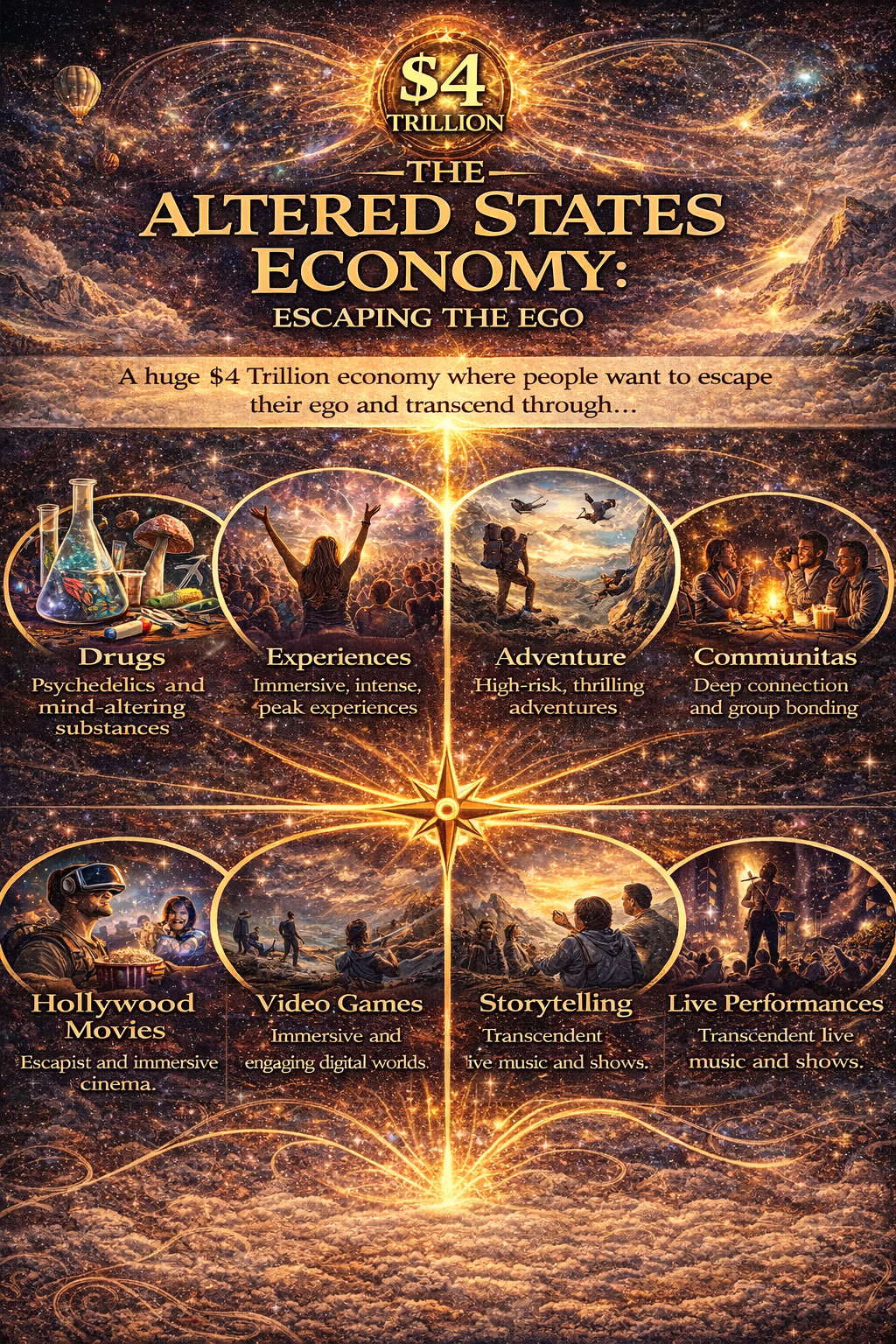
The economics of the experience economy are fundamentally different from the economics of content. Digital products scale infinitely with near-zero marginal cost.
Experiences scale through quality, not quantity. A digital course can sell to 10,000 people at $97 each. That is $970,000 in revenue, but with diminishing impact per customer.
A retreat can serve 20 people at $3,000 each. That is $60,000 in revenue, but with life-changing impact per customer and much higher lifetime value.
The first model scales revenue. The second scales transformation and reputation.
In the experience economy, competition is limited by capacity and quality. Not everyone can design and facilitate transformative experiences.
Not everyone can create the psychological safety, group dynamics, and environmental conditions that deep learning requires.
This creates a moat around experience-based businesses that content businesses simply do not have.
Pricing power follows. When you sell information, you are competing with free. When you sell transformation, you are competing with the cost of not changing.
A $2,500 retreat is not expensive compared to the cost of staying stuck, compared to years of therapy, compared to missed opportunities.
The most successful businesses in the experience economy price based on value delivered, not hours invested. They understand that customers are not buying time. They are buying breakthroughs.
Customer acquisition works differently. Content businesses rely on funnels and ads. Experience businesses rely on word-of-mouth, reputation, and community.
A single transformative experience creates evangelists who tell everyone they know.
The difference is that experiences create stories, and stories are the most powerful marketing there is.
Lifetime value is another key differentiator. A customer who buys a course might buy another course eventually.
A customer who attends a retreat often becomes part of a community, returns for advanced programs, refers friends, and stays connected for years.
The experience is not a transaction. It is the beginning of a journey.
The hybrid model is emerging as the sweet spot. Use content to attract and educate, use experiences to transform and deepen.
A YouTube channel builds audience and trust. A newsletter nurtures relationship. A workshop or retreat creates the transformation that builds loyalty and community.
This funnel combines the scalability of digital with the impact of in-person. The future belongs to businesses that understand this hybrid approach.
They will scale their reach through content, but scale their impact through experiences in the experience economy.
Business Model Comparison:
| Content Economy | Experience Economy |
|---|---|
| Scales infinitely | Scales through quality |
| Competes with free | Competes with cost of not changing |
| Low pricing power | High pricing power |
| Funnel-driven marketing | Word-of-mouth marketing |
| Transactional relationships | Long-term community |
| Commoditization risk | Differentiation through quality |
The Future Of Education Is Experiential Learning
The shift toward experiential learning is not a future trend. It is happening now. The experience economy is exploding across every domain.
Executive education is moving from classrooms to experiential simulations. Leadership development is incorporating nature-based challenges and somatic practices.
Wellness is shifting from information to immersion. Retreats, cleanses, intensives.
The pandemic accelerated this shift. When everything moved online, we discovered the limits of virtual connection.
As the world reopened, there was a hunger for real connection, for being in the same room, for shared experiences that digital platforms cannot replicate.
This hunger is deepening. People are more selective about how they invest their time and attention, and they are choosing experiences over content.
The demographics driving this shift are clear. Millennials and Gen Z prioritize experiences over possessions.
They value authenticity, community, and personal growth. They are skeptical of traditional credentials but deeply responsive to genuine transformation and peer recommendation.
They do not want to be sold to. They want to be invited into journeys that matter.
Technology is not the enemy of the experience economy. It is an enabler. Virtual reality can create immersive experiences that were previously impossible.
AI can personalize learning journeys and provide real-time feedback. Online platforms can facilitate community and integration between in-person experiences.
The most innovative businesses in the experience economy are using technology to enhance, not replace, human connection.
The implications are profound. If you are a teacher, creator, or expert, your future relevance depends on your ability to translate your knowledge into experiences that create transformation.
This does not mean you have to run retreats. It means you have to think experientially about how you deliver value.
How can you create engagement? How can you facilitate practice? How can you build community around your work?
For organizations, companies that invest in experiential learning will see returns in engagement, retention, and performance.
Training that is experienced, not just consumed, creates behavior change. Leadership development that includes real challenges builds better leaders.
For society, we face complex challenges that cannot be solved through information alone. Climate change, inequality, polarization.
These require not just understanding, but transformation.
The experience economy, at its best, is not just about personal growth. It is about collective evolution.
The retreats, workshops, and immersions of the future will be laboratories for new ways of being together.
This is the opportunity. You are not just selling travel or education or coaching.
You are selling experiences that change how people see themselves and the world. You are creating containers for transformation that ripple out into families, communities, and organizations.
You are building the future of learning, one experience at a time.
In the experience economy, credentials matter less than contributions. Certificates matter less than capability. Information matters less than transformation.
The question is not whether this shift is happening. It is whether you will lead it or follow it.

I believe the future of education starts with helping people find their "zone of genius" so they can develop their uniquely human ability to create meaning, connection and community (that A.I. can't replicate).
I'm also big on completely unplugging from tech to recharge on nature retreats and trekking adventures. That led me to start my most recent company Sacred Treks, where we help people reconnect with nature on wild trekking pilgrimages.
- The Experience Economy: This Is The Future of Learning - February 4, 2026
- Social Entrepreneurship: The New Path to 21st Century Leadership - February 2, 2026
- The Age of Belonging: Why Social Entrepreneurs Will Win In The AI Era - January 26, 2026