


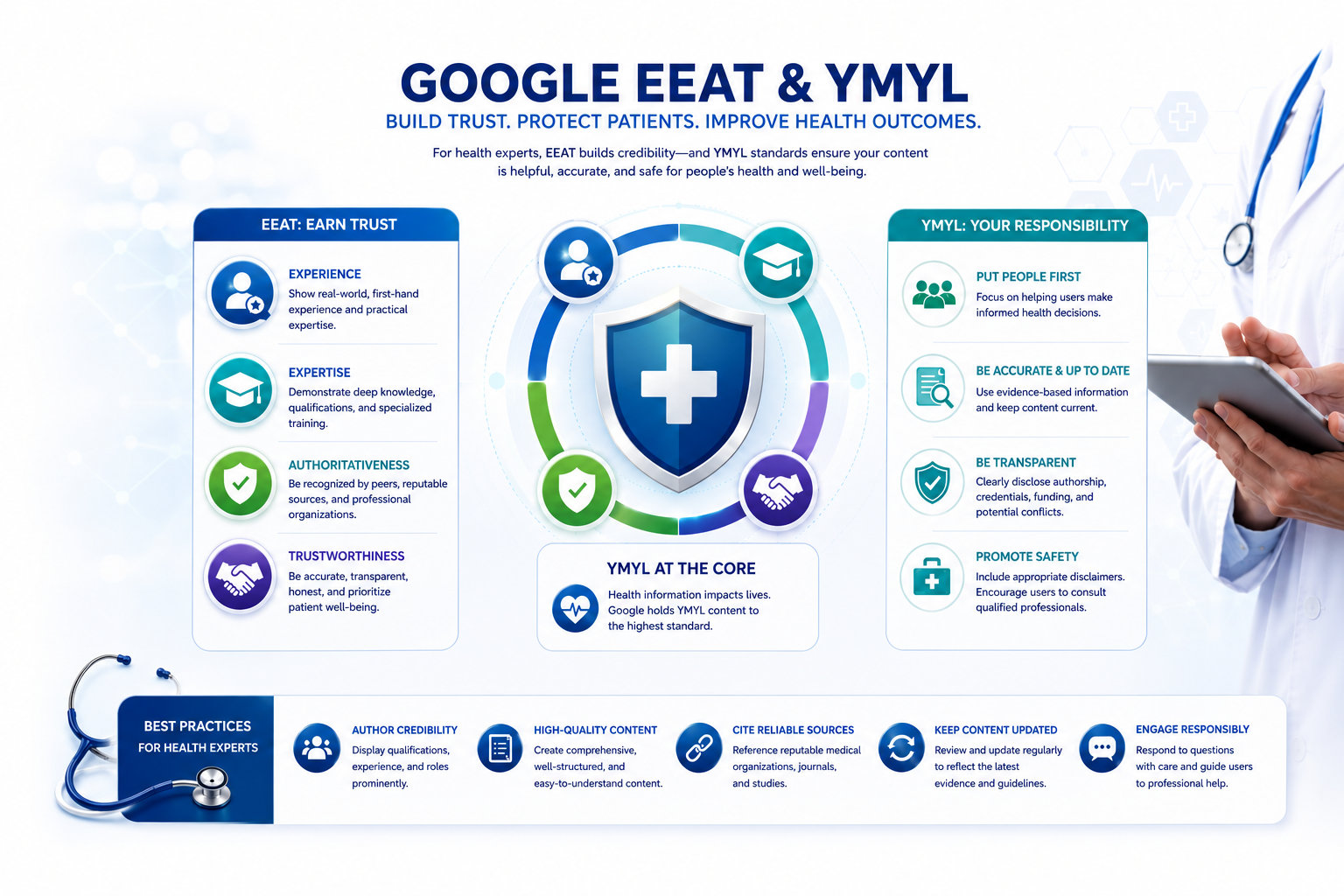
If you run a health website, you are playing search on hard mode. Google holds medical content to a higher standard than almost any other topic, and the framework it uses to define that standard is E-E-A-T: Experience, Expertise, Authoritativeness, and Trust.
I’ve worked with many health brands to get them ranking on Google in the last decade and in that time, I’ve learned a lot about the nuances of building authority in the eyes of Google for health experts.
This SEO guide for health professionals breaks down what E-E-A-T means for health content, why health sites face the toughest version of it, and what doctors, practitioners, and health coaches each need to do differently.
If you want to rank highly on Google and get cited by AI search algorithms, you must understand the foundations of Google’s E-E-A-T method of assessing trust and authority.
Why E-E-A-T Is Not A Ranking Factor
First, Google has said that there is no E-E-A-T score sitting on your pages. The thousands of human quality raters who use the E-E-A-T criteria do not touch your rankings. They rate sample search results so Google can check whether its algorithm is doing a good job.
So why does it matter?
Because Google builds its ranking systems to reward the same signals raters are trained to spot. The guidelines tell you, in plain language, what a trained evaluator treats as credible. That is a map of what the algorithm is trying to approximate. F
For controversial health topics, Google has said its systems give more weight to content that lines up with strong E-E-A-T.
Treat E-E-A-T as a description of the target and the way to build a strong SEO foundation, not a switch you flip to get quick rankings.
How Google Assesses Trust And Authority of Experts
Google added the second E, Experience, in December 2022. Before that, it was just E-A-T but the order on the page is not the order of importance.
Trust sits at the center. Experience, expertise, and authoritativeness all feed it. A page can be written by a leading expert and still fail if the site looks shady, hides who is behind it, or makes claims it cannot back up.
This is why mass AI-generated content websites almost always fail to rank, and even if they do, they tend to get penalized and drop off the rankings over time. Health content must be connected to a trusted expert.
Here is what each aspect of E-E-A-T means for a health website.
Experience is firsthand knowledge. Have you treated this condition, run this protocol, recovered from this injury yourself? Google added this E specifically because lived experience carries information that credentials alone do not.
Expertise is formal knowledge and skill. Training, clinical depth, the credentials behind the advice.
Authoritativeness is reputation. Are your site and your authors known and cited by other people in the field, not just by you?
Trust is whether people can rely on what you publish and on the site itself. Accurate claims, secure pages, clear ownership, honest framing. Google calls trust the most important member of the group.
Why Health Websites Get The Strictest Version Of YMYL
Google sorts some topics into a bucket called Your Money or Your Life, or YMYL.
These are subjects where wrong information can damage someone’s health, finances, or safety. In September 2025, Google expanded the category to spell out elections and civic institutions, but health has always been the core of it.
Health is the most scrutinized YMYL category there is. A page about the best running shoes can be a little loose. A page about drug interactions cannot. Google applies its highest quality standards here, so weak author signals, missing sources, or outdated advice cost you more than they would on a recipe blog.
This is the part that generic SEO advice gets wrong. Keyword research and backlinks will not save a medical page that has no named author, no review, and no citations. The trust problem comes first, and no amount of on-page optimization buys your way past it.
1. Experience: The Pillar Health Coaches Can Win On
Experience is the lever for anyone without a medical degree, and that includes most health and wellness coaches.
Google has been explicit that experience does not have to be academic. You can show it through direct use of a protocol, a real case, your own measured results, or work with clients over time.
It is certainly true that a certified physician writing about hypertension holds an important kind of credibility. Someone who reversed their own type 2 diabetes and documented every step holds a different kind. Both can be useful, depending on what the reader came for.
For a health coach, this is the opening. You may not be able to write with clinical authority about pathology or prescribe anything, but you can write with real authority about what a 12-week elimination diet actually feels like, where clients quit, and what made the difference. That is firsthand information a medical textbook does not contain, and Google’s December 2022 update was built to reward exactly this.
The catch: experience does not let you make medical claims you are not licensed to make. More on that below because this point is very important.
2. Expertise: Who Should Be Writing Your Medical Pages
For anything clinical, the safe pattern is simple. A licensed professional writes the page or reviews it, and their name and credentials are on it.
That professional does not have to be an MD. Depending on the topic it might be a DO, NP, PA, registered dietitian, physical therapist, or licensed clinical social worker. Match the credential to the claim. A page about meal planning for kidney disease should carry a renal dietitian, not a generic “wellness team” byline.
A ghostwritten symptom page with no author and no review will not outrank the Mayo Clinic or even show up at all. That is not a keyword gap; it is a trust gap, and Google reads it as one.
3. Authoritativeness: Reputation You Build Off Your Own Site
You cannot declare yourself authoritative. Other places have to do it for you.
For health websites, that reputation gets built in a few concrete ways. Claim and complete your profiles on medical directories like Healthgrades, Vitals, Zocdoc, and RateMDs, because each one is an authoritative listing that confirms your credentials across the web.
If your clinicians have hospital privileges, get the hospital site to link to them. Earn mentions in health journalism and get cited by other practitioners or academic institutions that you work with regularly.
Brand mentions matter even without a link. Google is increasingly good at connecting an author or practice to a real-world identity, and consistent references to that identity across reputable sites build the entity-level authority it looks for.
For local practices, your Google Business Profile and your patient reviews do heavy lifting here. A practice with 47 reviews averaging 4.8 stars usually beats one with 12 reviews at 5.0, both for local rankings and for whether a ranked page actually converts.
4. Trust: The Foundation Everything Else Sits On
Trust is the one to get right first, and there are a few key things that carry most of the weight.
You have to run your website on HTTPS and it needs to contain real contact information, an about page, and clear ownership. State your privacy practices, and if you are in the US handle patient data with HIPAA in mind.
Cite primary sources for medical claims and link to peer-reviewed journals such as JAMA, The New England Journal of Medicine, BMJ, or Cochrane Reviews, and to agencies like the CDC, NIH, and WHO. Citing another blog does not count. Citing Healthline instead of the study it summarizes does not count.
Keep your website’s health content current. Outdated medical advice is a trust failure, not just a freshness one. Put a real “last reviewed” date on clinical pages and review them at least once a year. Pull or fix anything that references a withdrawn drug or a superseded guideline.
Doctors, Practitioners And Coaches: Handling The Credential Gap
The three audiences need different playbooks, mostly because of where they sit on credentials.
Doctors and licensed practitioners have the expertise pillar handled. Your work is to make it legible. Put credentials, board certifications, your NPI, and hospital affiliations on a real bio page. Sign your content and add a named medical reviewer when someone else wrote the draft. The expertise is real, so the job is documentation.
Health and wellness coaches sit in a different spot, and pretending otherwise backfires. You must lead with experience, not clinical authority. Write about behavior change, adherence, lifestyle, and what you have seen work with clients, which is ground you can own. For anything that crosses into diagnosis, treatment, or medication, cite a licensed source and defer to it rather than posing as the authority. This protects you legally and reads as more trustworthy to both Google and your audience, because an honest scope is itself a trust signal.
If you are a coach who wants to rank for clinical terms, bring in a licensed reviewer. A “medically reviewed by [name, credential]” line on the page closes the expertise gap without you claiming a license you do not hold.
The Build Checklist For Health Website SEO
Here is the practical setup for a health page that holds up. Work through it page by page.
- A named author with credentials, linked to a full bio page.
- A named medical reviewer when the author is not the clinician, with a “medically reviewed by [name, credential]” line near the top.
- A visible “last updated” or “last reviewed” date, refreshed at least annually.
- In-text citations to primary medical sources, not to other blogs.
- A bio page per author listing qualifications, board certifications, NPI where relevant, and affiliations.
- HTTPS, contact details, an about page, and a privacy policy.
- Completed profiles on Healthgrades, Zocdoc, Vitals, and other relevant directories.
- Structured data: MedicalWebPage, Physician, and MedicalClinic schema where they apply.
- A review-generation step built into your patient or client workflow.
A page that hits most of this withstands core updates. A page that misses half of it is exposed every time Google reassesses quality.
What AI Content Did To The Rules
Google updated its helpful-content guidance in December 2025 and ran a core update the same month that hit generic AI content hard. The rules are now explicit.
Google does not care whether a human or an AI wrote the page. It cares whether the result shows real expertise, is accurate, and has someone accountable for it. The guidance frames it as who, how, and why. Who made this, how was it produced including any AI use, and why does it exist.
AI-generated health content can pass if a qualified person reviews it, it adds original data or insight, a named author stands behind it, and it answers a real question rather than chasing search volume. The same content fails when it is mass-produced, unreviewed, and just rephrases what already exists. Google’s January 2025 update named that pattern, scaled low-effort content, and set it at the lowest quality rating regardless of who or what produced it.
For health sites the takeaway is blunt. Drafting with AI is fine. Publishing unreviewed AI medical content with no author is the fastest way to get buried.
Getting Cited In Google’s AI Overviews
AI Overviews and AI Mode now sit at the top of many health searches, and the September 2025 guidelines added criteria for rating them. The sources these summaries pull from skew heavily toward content with strong trust signals, which means the same E-E-A-T work pays off twice.
To get pulled into AI answers, answer the question early and directly, then support it. Structure pages so a single clear answer is easy to lift. Add FAQ and MedicalCondition schema so AI systems can parse what the page covers. And lean on the material an AI cannot fabricate. Your own cases, original data, and real photos are the strongest thing standing between your page and a “low-effort content” label.
Mistakes To Avoid That Sink Health Websites
A few errors show up again and again.
Anonymous content is the big one. A medical page with no author and no reviewer reads as untrustworthy by default. Outdated advice is next, especially a post from three years ago that still ranks but now contains obsolete guidance. Thin pages that restate what ten other sites already said add no value and Google knows it. Missing HTTPS or hidden contact details quietly drag down the whole domain. And citing other blogs instead of the underlying research tells Google you are summarizing, not sourcing.
None of these are keyword problems. All of them are trust problems, which is the whole point of E-E-A-T for health.
What To Do Right Now To Improve Your Rankings
Pick your five most-trafficked health pages and check each one for a named author, a reviewer, a recent review date, and primary-source citations. Fix whatever is missing.
Then, build out one proper author bio page with credentials and affiliations. Claim any medical directory profile you have not claimed.
That is a single afternoon of work, and on a health website, it moves more than another month of keyword research will.

I believe the future of education starts with helping people find their "zone of genius" so they can develop their uniquely human ability to create meaning, connection and community (that A.I. can't replicate).
I'm also big on completely unplugging from tech to recharge on nature retreats and trekking adventures. That led me to start my most recent company Sacred Treks.
- 10 Best AI Wearables That Can Help Your Focus And Productivity - June 26, 2026
- 4 Pillars of How Google’s EEAT Shapes SEO For Health Websites - June 25, 2026
- 11 Best Digital PR Tools That Help Founders Get Cited By AI - June 25, 2026