

I’ve been testing brain gadgets for years and tDCS is something I’ve only recently had a chance to try out and I’ve been really impressed by the technology.
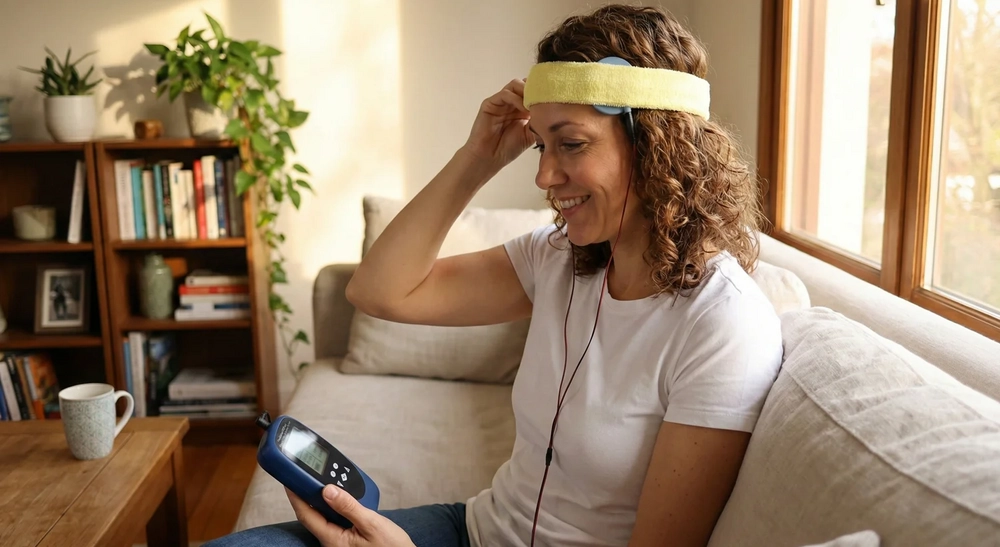
You clip a band on your head, run a mild current across your scalp for 10-20 minutes, and your brain gets a little easier to push into focus. It sounds like science fiction but it really isn’t. Researchers have used this method for over two decades, and the hardware is now cheap enough to sit on your desk next to your coffee.
Quick note on the name before we go further. You’ll see it typed as TCDS, tCDS, or tDCs. The correct term is tDCS, which is short for transcranial direct current stimulation.
This guide covers the best devices available right now in 2026, what each one is good at, what they cost, and where the science is solid versus where the marketing runs ahead of it.
What is transcranial direct current stimulation (tDCS)?

tDCS sends a weak direct current, usually between 0.5 and 2 milliamps, between two electrodes on your head. The positive electrode (the anode) makes the neurons under it slightly more likely to fire. The negative one (the cathode) makes them slightly less likely to fire. It doesn’t force your brain to do anything; it just tilts the balance.
Here’s how tDCS differs from other wearable tech and wellness protocols. Most biohacking tools either track you or treat your body. Your Oura ring measures sleep. Red light works on your skin and mitochondria. A cold plunge hits your nervous system through temperature. tDCS aims at the brain itself and tries to shift how it works for an hour or two after you take the band off.
The current is tiny. One widely cited safety review compared a tDCS session to wiring a 9-volt battery to your scalp, which is roughly what’s happening. That low power is why the side-effect profile is mild, and it’s also why nobody should expect a lightning bolt of genius.
What it can do, based on the research: anodal stimulation over the left dorsolateral prefrontal cortex, the spot labelled F3 in EEG terms, is the most-studied setup for attention, working memory, and mood. In healthy adults, the effects are real but small.
Typically, tDCS sessions become more reliable when you stack sessions over weeks and run the stimulation while you do the actual task you want to get better at. A 2021 meta-analysis of surgical trainees found a moderate benefit for skill acquisition, which is why athletes and surgeons keep turning up in the literature.
What it can’t do: it won’t rewrite your IQ, and the response varies a lot person to person. Some people feel a clear lift. Others feel nothing at all. I land in the middle, and I’ve learned to treat tDCS as a small edge on a good day, not a switch I flip.
While achieving “flow state” sells headsets, there are almost no studies that measure flow directly. What the research measures is attention, reaction time, working memory, and motor learning. Those overlap with what flow feels like, so the framing isn’t dishonest, but treat any promise of instant flow as clever marketing.
Why I put this tDCS guide together
I’m Kyle Pearce, founder of DIY Genius. For the better part of a decade, I’ve been obsessed with improving focus, energy, and motivation through biohacking and tech wearables. I’ve tested all kinds of different biohacking devices, and tDCS is something I’ve only recently begun playing around with.
Many of the companies behind these devices send them to me directly to test. That means I’ve spent real time using most of what’s on this list, not just reading spec sheets. I know what the marketing says and I know what daily use actually feels like.
That experience shapes how I’ve written this guide. I’ve tried to be straight about what’s worth the money, what the apps are actually like to use, and where the research is solid versus where it’s thin.
This guide is for education, not medical advice. tDCS devices sold for focus and wellness are not treatments for any medical condition. Talk to a qualified clinician before using neurostimulation, especially if you have a health condition or take medication.
A short safety note about tDCS wearables
Side effects are usually minor: a tingle, an itch, or a warm patch under the electrodes, sometimes a brief headache or a bit of fatigue afterward. Flow Neuroscience, which has the largest real-world dataset, reports a self-reported side-effect rate of about 4.5% across more than 40,000 users.
Some people should skip tDCS or talk to a doctor first. That list includes anyone with epilepsy or a seizure history, a pacemaker or any implanted electronic or metal device in the head, broken or irritated skin at the electrode sites, and anyone who is pregnant. Follow the current and time limits your device sets, keep sessions to about 20 minutes, and don’t stimulate every single day forever without breaks.
None of this is medical advice, and none of these devices treat a medical condition unless it carries a regulator’s sign-off that says so. Only one on this list does, and I’ll flag it clearly when we get there.
Now the devices. I’ve put the grab-and-go branded headsets first, then the DIY units for people who want to build their own sessions.
1. Zendo Meditation
Best for: people who want a low-cost, research-backed headband for calmer meditation and wind-down, with nothing to set up.

I’ve been following Zendo for a couple of years and their device is now finally ready for prime time. It’s a tDCS headband built by Bodhi Neurotech out of Charleston, South Carolina, aimed squarely at meditation, calm, and wind-down rather than raw productivity. At only $119 it’s the cheapest branded headset on this list, and it’s the one with the most serious research behind it, which is a rare pairing.
The setup is about as simple as it gets. A low-level current runs through a saline pad over your prefrontal cortex for a 20-minute session. You snap on a fresh pad, tap to pick an intensity, and press start, and the session ends on its own. No app, no program, no montage to learn. The headband recharges over USB-C and ships with 20 single-use pads; refills run $14.99 for ten, which works out to roughly 60 cents a session. You feel a light tingle where the pad sits, and it fades within a minute.
What sells me on Zendo is the pedigree and the honesty. The co-founders, Bashar Badran and Baron Short, ran the E-Meditation research at the Medical University of South Carolina, and Badran is a known name in the brain-stimulation field. Their double-blind, sham-controlled study in the journal Brain Stimulation found that pairing real stimulation with guided meditation cut restlessness and improved mindfulness measures compared with a sham group. The marketing keeps that same restraint: they tell you about the tingle, the ongoing pad cost, and the limits of the evidence up front.
The trade-offs are real. It’s tuned for calm and meditation, so if you’re chasing hard focus or a flow state at your desk, LIFTiD or Mave fit the brief better. The single-use pads are an ongoing cost and a bit of waste. Placement is fixed over the forehead, so there’s no experimenting with montages. And like almost everything here, it’s a general wellness product, not a treatment for anything. But of the plug-and-play headsets, this is the one whose makers actually did the peer-reviewed work, and at $119 it’s the easiest yes for a beginner.
Pros:
- Cheapest branded headset ($119), no subscription
- Built by MUSC brain-stimulation researchers, with a published sham-controlled study
- No app, 20-minute sessions, unusually honest marketing
Cons:
- Single-use saline pads are an ongoing cost
- Tuned for calm and meditation more than hard focus or flow
- Fixed placement, general wellness product, early consumer evidence
2. Flow Neuroscience FL-100
Best for: adults treating depression at home, ideally with clinical guidance. Not a focus device.

Flow is the big story of 2026, and it’s a different animal from else on this tDCS wearable list. This Swedish headset targets depression, not desk focus, and in December 2025 the FDA approved it as the first at-home brain-stimulation device cleared specifically to treat major depressive disorder. Before that clearance, it had already been used by more than 55,000 people across the UK and Europe, where NHS clinicians prescribe it.
Here’s how the treatment works. It runs anodal stimulation over the left dorsolateral prefrontal cortex, an area that tends to be underactive in depression, across a roughly 12-week course of five sessions a week, paired with a behavioral therapy app. In Flow’s Empower phase 2 study, 58% of patients reached remission. The real-world side effect rate sits around that same 4.5% figure, mostly the usual tingling and skin sensations.
Access and price split by region. In the US, it launched in the second quarter of 2026 as a prescription-only product, with a retail price of $500 to $800 and insurance details still being worked out. In the UK and EU, you can buy the headset directly, roughly in the $300 to $500 range, and pair it with an app subscription; no prescription required.
My take is simple: this isn’t a focus toy, and I wouldn’t buy it to chase flow. It’s a medical device for mood, and that’s a pretty big innovation for people struggling with depression. It’s the first tDCS product to clear the FDA’s highest bar for a home device, and that clearance pulls the entire category toward legitimacy and, eventually, insurance coverage. If you’re dealing with depression, this is a conversation with a doctor, not a weekend biohack.
Pros:
- First FDA-approved at-home tDCS device for depression
- Large clinical and real-world evidence base
- Structured app-guided program, strong safety record
Cons:
- Treats depression, not focus or flow
- US access is prescription-only and pricier
- Long 12-week commitment, ongoing app cost
3. Mave Health
Best for: people who want an app-driven focus and mood headset with built-in tracking, and who’ll treat the data as a personal experiment.

Mave is the newest headset here and the one built most deliberately for the always-on, overloaded modern brain. The company runs out of San Francisco and Bengaluru, founded in 2023 by Dhawal Jain, Jai Sharma, and Aman Kumar, and it grew out of the founders’ frustration with how hard mental health support is to reach. It’s a tDCS wearable aimed at three things: focus, mood, and stress regulation, in a 20-minute daily session over the prefrontal cortex.
The hardware is light and quiet. It weighs about 100 grams, delivers a standard 1 to 2 mA, and it’s built so you can wear it and get on with your day instead of sitting still. What sets it apart from most of the field is the app. It logs each session, lets you personalize protocols, and tracks long-term trends in mood, focus, and stress. It also pulls in other health data, including heart rate variability, and it deliberately doesn’t collect any brain data. You start with a baseline self-assessment and repeat it every few weeks so you can see whether it’s doing anything.
Mave is the most measurement-minded consumer device on this list, and that’s the part I like. Most tDCS gear stimulates and leaves you guessing. Mave at least tries to close the loop with self-reported tracking and HRV, which fits how I test everything else. It’s priced at $495 with no subscription, which is refreshingly honest, and shipping to the US and India began in late 2026 after a beta run of more than 500 users.
Now, the caution, because it’s the same one I’d apply to my own results. Mave’s headline numbers, things like large productivity and mood gains after four weeks, are self-reported by its own users, not results from a controlled trial. The company sells it as a non-medical device, so it carries no FDA clearance.
The one thing to keep in mind is that independent researchers have flagged that tDCS for lifestyle use in healthy people is still thin on hard evidence. Leigh Charvet, a neurology professor at NYU, put it plainly: the strong research is in clinical populations, and a lifestyle case still has to be proven. Treat the tracking as a way to test the device on yourself, not as proof it works.
Pros:
- App tracks mood, focus, stress, and HRV over time
- Light (~100 g), wear-and-go design, no subscription
- Standard, well-studied 1 to 2 mA prefrontal setup
Cons:
- Headline benefit stats are self-reported, not from controlled trials
- New device with a short track record
- Non-medical, no regulatory clearance
4. PlatoWork (PlatoScience)
Best for: professionals who want an app-guided, mode-based headset for focus and creative work and can source one.

PlatoWork is the best-designed consumer headset of the group, and it takes a different approach: instead of dialling current and time, you pick a mode in an app for the mental task in front of you. The Danish maker, PlatoScience out of Copenhagen, built it around modes like Learn, Create, Concentrate, and Rethink. Around $429, and it looks and feels like a finished product rather than a gadget.
The hardware is genuinely clever. It has three electrodes, each of which can act as anode or cathode, and the headset tilts to three positions on your head, so a single device covers dozens of montages. The PlatoApp on iOS and Android runs the whole thing, there’s no subscription, it fits heads from 54 to 64 cm, and it ships with a two-year warranty.
The mode-and-app model is the most beginner-friendly of the smart headsets. You aren’t reasoning about the prefrontal cortex, you’re choosing “concentrate” and starting a work block. For focus and creative sessions at a desk, that framing lowers the barrier a lot. It’s the device I’d point a nontechnical professional toward.
Two honest cautions. It’s the priciest consumer option here, and PlatoScience has shifted toward practitioners and clinics, so an individual buyer may now need a healthcare provider to order one rather than adding it to a cart. The company also runs a separate depression-focused line, PlatoCare, under a stricter EU medical classification. And those tidy mode names promise more precision than the science can currently back. If you want a designed product over a bare circuit, this is still the one.
Pros:
- App-driven modes make it approachable
- Flexible three-electrode design, many montages
- No subscription, two-year warranty, polished build
Cons:
- Most expensive consumer option
- Availability for individuals has narrowed toward practitioners
- Mode names imply more precision than research supports
5. LIFTiD Neurostimulation
Best for: busy people who want plug-and-play focus and don’t want to learn montages.

LIFTiD is the simplest way into tDCS, full stop. It’s a padded headband with a single button, built by Ken and Allyson Davidov, who pitched it on Shark Tank in 2020. The whole idea is to replace the afternoon coffee or energy drink with 20 minutes of gentle stimulation. Around $149, and you can have it running in under a minute.
There are almost no specs to report, and that’s the point. It delivers a fixed 2 mA over one preset frontal montage for 20 minutes a day. No app. No current dial. No timer to set. No 10-20 positioning system to memorize. You put it on, press once, and get to work while it runs.
I recommend this to people who want the effect without the hobby. Anyone who hears “prepare the saline sponges and locate F3” and immediately loses interest is the ideal LIFTiD buyer. The padded electrodes sit against your forehead, the placement is baked in, and there’s genuinely nothing to get wrong. It’s aimed at students, gamers, writers, and desk workers, and that’s a fair fit.
The flip side of that simplicity is zero flexibility. Fixed current, fixed spot, fixed time. If your head shape doesn’t match where the electrodes land, contact suffers and you can’t adjust much. Experimenters will outgrow it in a week. But as a no-friction first taste of what tDCS feels like, nothing else is this easy.
Pros:
- Single button, no setup, no app
- Comfortable padded electrodes, fixed placement
- Cheap enough to try the technology risk-free
Cons:
- No flexibility at all (fixed current, spot, and time)
- Fit issues if your head shape differs
- Nothing to experiment with
6. The Brain Premier (Caputron)
Best for: beginners who want the most accurate, easiest-to-use tDCS device without paying clinical-grade prices.

The Brain Premier is the budget device I’d hand a beginner now. It’s Caputron’s entry-level unit, the little sibling to the clinical-grade ActivaDose further down this list, and it lands around $175 while doing most of what pricier devices do. It holds a 4.68 out of 5 across 65 reviews, and the tDCS review hubs tend to put it at the top of their budget picks.
Unlike the cheapest kits, the Brain Premier uses constant-current delivery and watches your electrode contact in real time, adjusting to hold the current you set steady as your skin resistance shifts mid-session. That accuracy is the difference between a controlled session and a guess, and it’s rare at this price. It also ships with a pre-marked placement cap, so you’re not eyeballing F3 with a tape measure. For a first device, that combination is hard to beat.
The rest of the sheet is generous for the money: current in fine 0.1 mA steps up to 4 mA, a rechargeable battery with a low-battery light, a center-wheel interface to set current and time and to pause mid-session, a timer up to 40 minutes, automatic ramping, a sham mode for self-testing, an LCD, and CE marking. Setup still uses saline sponges, but the cap does the hard part of placement for you.
The catches are minor. It’s a wellness device, not FDA cleared for anything, and it sells out from time to time. The looks are humble, closer to a first-generation iPod than a medical instrument. And electrode placement still has a small learning curve, though the marked cap and the included instructions shorten it. None of that changes the verdict: at this price, it’s the most accurate easy-to-use tDCS unit I know of.
Pros:
- Constant-current with live contact monitoring, accurate at a budget price
- Pre-marked placement cap removes most setup guesswork
- Fine 0.1 mA control, rechargeable, sham mode, CE marked
Cons:
- Wellness device, not FDA cleared, and sometimes out of stock
- Still uses saline sponges, with a small placement learning curve
- Plain, utilitarian design
7. TheBrainDriver v2.1
Best for: first-timers who want a real, adjustable tDCS device without spending much.

TheBrainDriver is the budget workhorse of DIY tDCS, and the unit I point people to when they want to build their own sessions cheaply. It comes from a small Chicago company founded by Alex Heredia, a yoga practitioner and cyclist who built it for what the site calls peak performance types. Nothing fancy. Just a solid, honest little machine.
On specs it covers what most people need. Current runs from 0.5 to 2.0 mA, adjustable. You get 20 or 30 minute timers, a backlit display, automatic ramp up and ramp down so the current eases in and out instead of jolting you, and a pause-detection feature that shuts things off if an electrode loses contact. It ships ready to use with a 9-volt battery and the sponges, electrodes, and headband you need for a first session.
Using it is a saline-sponge affair. You wet the sponges, seat them in the electrode pockets, strap the band so the anode sits over F3 and the cathode over the opposite forehead or temple, and press start. There’s no app and no tracking, which I actually like for a starter device. Fewer things to fiddle with means you spend your attention on the session, not the software.
The downsides are the ones you’d expect at this price. You place the electrodes yourself, so a bad montage is on you. The wet sponges are a small chore. Current tops out at 2 mA, which is fine since that’s what most studies use, but tinkerers who want to push higher will feel boxed in. For a first adjustable tDCS unit, none of that bothers me.
This is the closest to the original do-it-yourself tDCS called the Brain Stimulator that kicked off interest in this technology over a decade ago.
Pros:
- Cheapest way into genuine adjustable tDCS
- Simple, reliable, no app or account needed
- Real safety features (ramp, auto-shutoff, timer)
Cons:
- Manual electrode placement, wet sponges
- No app, no session data, no higher current
- Basic build compared to clinical units
8. Foc.us Go Flow 4
Best for: experienced users and tinkerers who want portability and more than one waveform.

foc.us out of London were early to consumer tDCS, and the Go Flow is their smallest device by a wide margin. It’s about the size of your thumb. I keep one in my travel bag because it disappears into a pocket and runs off a single 9-volt battery for thousands of sessions.
Where it gets interesting is the range of stimulation. The Go Flow pushes up to 4 mA, double what most devices offer, and it does more than plain direct current. It supports tACS (alternating current), tRNS (random noise), tPCS (pulsed current), and a slow-oscillating mode at 0.75 Hz that some people run before sleep. Sessions go from 1 to 35 minutes with smooth ramping. Instead of a screen, you read your settings off backlit LED indicators.
This is a power user’s toy. The 4 mA ceiling and the waveform variety let you experiment in ways the simpler bands can’t. But 4 mA sits above the 2 mA that most research is built on, so the extra power puts responsibility on you to monitor how you feel and back off if anything gets uncomfortable. The company even says as much.
Two honest gripes with this device. There’s no screen, so you don’t get a precise numeric readout of what’s flowing, only the LED steps. And at around $244 it’s one of the pricier compact options, with the brand’s own website feeling a bit chaotic to shop. If you’re brand new to tDCS, the power and modes are overkill. If you already know your way around, it’s the one I’d travel with.
Pros:
- Smallest device on the market, genuinely pocketable
- Up to 4 mA and multiple waveforms (tDCS, tACS, tRNS, tPCS, sotDCS)
- Long battery life, smooth ramping
Cons:
- No screen or precise numeric readout
- 4 mA exceeds typical study doses, so self-monitoring matters
- Pricier than simpler bands, messy web store
9. NeuroMyst Pro
Best for: hobbyists who want to run both tDCS and tACS and like real-time feedback.

The NeuroMyst Pro solves a problem most devices ignore: it gives you both tDCS (transcranial direct current stimulation) and tACS (transcranial alternating current stimulation) in one unit, so you don’t have to buy two. It’s made in the USA, sold directly to consumers and priced around $160.
The feature set punches above that price. Current runs from 0.1 to 4 mA in fine 0.1 mA steps. For alternating current, you get a frequency range up to roughly 80 Hz. It has a color LCD, a rechargeable battery good for about five hours per charge, and an impedance meter that shows your electrode contact quality with a simple green, yellow, or white color code. There are presets for beginners and full custom control for everyone else, plus ramping and a placebo mode.
I like this one for experimentation. The impedance meter is genuinely useful. Bad contact is the number one reason a tDCS session does nothing, and being able to see it before you start saves you from a wasted 20 minutes. The placebo mode is a nice touch too, because it lets you run a rough blind test on yourself to check whether you’re feeling stimulation or expectation. A neuroscientist review I came across bought it for exactly that reason.
Where it gives ground is polish. Build quality and the bundled accessories sit a notch below the clinical-grade units. The 4 mA ceiling again means you’re the safety monitor above 2 mA. And with more modes and settings comes a steeper learning curve than a one-button headband. For a hobbyist who wants to explore both current types with real feedback, though, it’s the best value here.
Pros:
- Both tDCS and tACS in a single device
- Fine current control, impedance meter, rechargeable
- Presets plus custom, placebo mode for self-testing
Cons:
- Build and accessories below clinical grade
- 4 mA option puts safety monitoring on you
- More settings mean more to learn
10. Caputron ActivaDose tDCS Starter Kit
Best for: researchers, clinicians, and serious DIYers who want clinical-grade current accuracy and full montage freedom.

The ActivaDose is as close to a medical-grade unit as you can buy without being a clinic. Caputron, based in New York since 2012, distributes clinical and research neurostimulation gear, and the ActivaDose is the device they put their name behind. It’s the only consumer-available tDCS unit whose hardware carries an existing FDA clearance, though I want to be precise about that: it’s cleared as an iontophoresis device and used off-label for tDCS, not cleared to treat any brain condition.
What you pay for is accuracy. The device runs 0 to 4 mA and, more importantly, monitors your skin impedance in real time and adjusts voltage on the fly to hold the current steady. Set 1.5 mA and you actually get 1.5 mA even as your sponges dry and contact shifts. The interface is two knobs, one for current and one for dosage and time, plus a high-contrast display and ramping. It meets the IEC 60601 standard for medical electrical equipment, which is why review boards clear it for use in university studies.
This is the unit I trust when I care about getting the dose right. The impedance-based regulation is the difference between a controlled session and a guess. Setup still involves saline sponges, a strap, and manual placement, so it isn’t plug and play, but the current you dial is the current you receive, and for research or careful self-experiment that’s the whole ballgame.
The trade-offs are price and polish. Depending on configuration and whether you buy new or certified pre-owned, it runs from about $249 to $449, the top end of the consumer market. The design is utilitarian, there’s no app, and you’ll need to learn montages. You’re buying precision, not a lifestyle product.
Pros:
- Clinical-standard build, IEC 60601 compliant
- Real-time impedance monitoring holds current stable
- Trusted in university and clinical research
Cons:
- Most expensive of the DIY-friendly units
- No app, utilitarian design, montage learning curve
- Wet sponge setup, not plug and play
Comparison chart of tDCS wearables and devices
| Device | Waveforms and tech | Max current | Interface | Approx. price (USD) | Best for |
|---|---|---|---|---|---|
| Zendo Meditation | tDCS, fixed placement | Low (not published) | On-device buttons, no app | ~$119 | Research-backed calm and meditation |
| Flow FL-100 | tDCS (medical) | App-controlled | Smartphone app | $500 to $800 | At-home depression treatment |
| Mave Health | tDCS + app tracking (mood, focus, HRV) | 2 mA | Smartphone app | ~$495 | App-tracked focus and mood |
| PlatoWork | tDCS (app modes) | App-controlled | Smartphone app | ~$429 | App-guided focus and creativity |
| LIFTiD | tDCS (fixed) | 2 mA | One button | ~$149 | Plug-and-play focus |
| The Brain Premier | tDCS (constant-current) | 4 mA | Center wheel + LCD | ~$175 | Most accurate budget starter |
| TheBrainDriver v2.1 | tDCS | 2.0 mA | Buttons, backlit screen, timer | $130 to $150 | Affordable first device |
| Foc.us Go Flow 4 | tDCS, tACS, tRNS, tPCS, sotDCS | 4 mA | LED indicators, no screen | ~$244 | Portable multi-waveform for power users |
| NeuroMyst Pro | tDCS, tACS | 4 mA | Color LCD, impedance meter | ~$160 | Best value dual-waveform |
| Caputron ActivaDose | tDCS | 4 mA | Two knobs, high-contrast display | $249 to $449 | Clinical-grade accuracy, research |
Where all this tDCS tech is heading
The Flow approval is the moment the category grew up. A home tDCS device clearing the FDA’s premarket bar tells insurers, doctors, and cautious buyers that this isn’t fringe anymore. Expect more clinical clearances, more physician involvement, and eventually reimbursement to follow.
The bigger technical shift is closed-loop stimulation. Today, every device on this list is open-loop: it pushes a set current for a set time and hopes your brain is in a state to use it. The research is moving toward devices that read your brain with EEG, detect when you’re actually in a focused or receptive state, and adjust the stimulation in real time to match. A 2024 pilot study did exactly this for sustained attention, tuning current and electrode site on the fly. That’s the direction the next generation of consumer hardware will chase.
Two other trends are worth watching. Labs are testing higher currents, 4 and even 6 mA, along with high-definition montages that use a ring of small electrodes to hit a target more precisely than the old two-sponge setup. And the whole field is wrestling with the same problem I keep hitting in my own sessions: response varies enormously between people. The future isn’t one protocol for everyone. It’s stimulation matched to your anatomy and your brain state, which is why personalization and home-neuromodulation ethics were headline topics at the 2026 NYC Neuromodulation conference.
My prediction: within a few years the interesting devices won’t just stimulate. They’ll sense first, then stimulate, and get smarter about who they actually help.
tDCS Wearable Device FAQ
Does tDCS actually work?
For healthy people chasing focus, the honest answer is: sometimes, a little. Meta-analyses show small effects on attention and working memory that grow more reliable with repeated sessions and when you stimulate while doing the task. Motor and skill learning show stronger, more consistent results. Treat it as a modest edge, not a miracle.
Is the technology considered safe?
For healthy adults following the device limits, the record is good. Side effects are mild and short: tingling, itching, a warm spot, occasionally a brief headache. Skip it or ask a doctor first if you have epilepsy or a seizure history, a pacemaker or implanted electronic or metal device in the head, broken skin at the electrode sites, or if you’re pregnant.
Will I feel anything?
You’ll feel the electrodes: a light tingle or itch as the current ramps up, which usually fades. The cognitive effect is subtle. If you’re expecting a jolt, you’ll be disappointed. Many people can’t tell a real session from a sham one, which is exactly why placebo and blinding modes are useful.
How often should I use it?
Most protocols run for about 20 minutes per session. Benefits tend to build over repeated sessions rather than one-offs, but daily forever isn’t the goal. Follow your device’s guidance and take breaks.
What’s the difference between tDCS, tACS, and TMS?
tDCS uses steady direct current to nudge neuronal excitability. tACS uses alternating current at a set frequency to interact with brain rhythms. TMS uses magnetic pulses that are strong enough to directly trigger neurons, which is why it’s a clinical tool, not a home gadget.
Can it replace coffee or a prescription stimulant?
No. LIFTiD and others market it as a caffeine alternative, and for a mild focus lift some people prefer it. But it’s not a substitute for medication, and nothing here treats ADHD or any condition unless a regulator says so. Flow is the only approved medical device on this list, and only for depression.
How do I know where to place the electrodes?
The most-studied focus montage puts the anode over the left prefrontal area (F3) and the cathode over the opposite forehead. Fixed devices like Zendo, LIFTiD, and PlatoWork handle placement for you. For the adjustable units, follow the manufacturer’s montage instructions rather than guessing.
Which should I buy first?
For calm and meditation, Zendo. For plug-and-play focus, LIFTiD. To build your own sessions cheaply, TheBrainDriver. To experiment with waveforms, NeuroMyst Pro. For dose accuracy or research, the ActivaDose. For depression, that’s Flow, and it’s a doctor conversation.
Is any of this FDA approved?
Flow’s FL-100 has full FDA approval, for treating major depressive disorder at home. Every other device here is sold for wellness and general use, not as a treatment for any condition. The ActivaDose hardware carries an older FDA clearance as an iontophoresis device, but that isn’t a tDCS treatment clearance.

I believe the future of education starts with helping people find their "zone of genius" so they can develop their uniquely human ability to create meaning, connection and community (that A.I. can't replicate).
I'm also big on completely unplugging from tech to recharge on nature retreats and trekking adventures. That led me to start my most recent company Sacred Treks.
- 10 Best tDCS Wearables For Focus, Flow And Relaxation - September 29, 2026
- 10 Breathing Training Devices For Improving How You Breathe - September 28, 2026
- The 30 Most Profitable High-Ticket Coaching Niches - September 16, 2026