


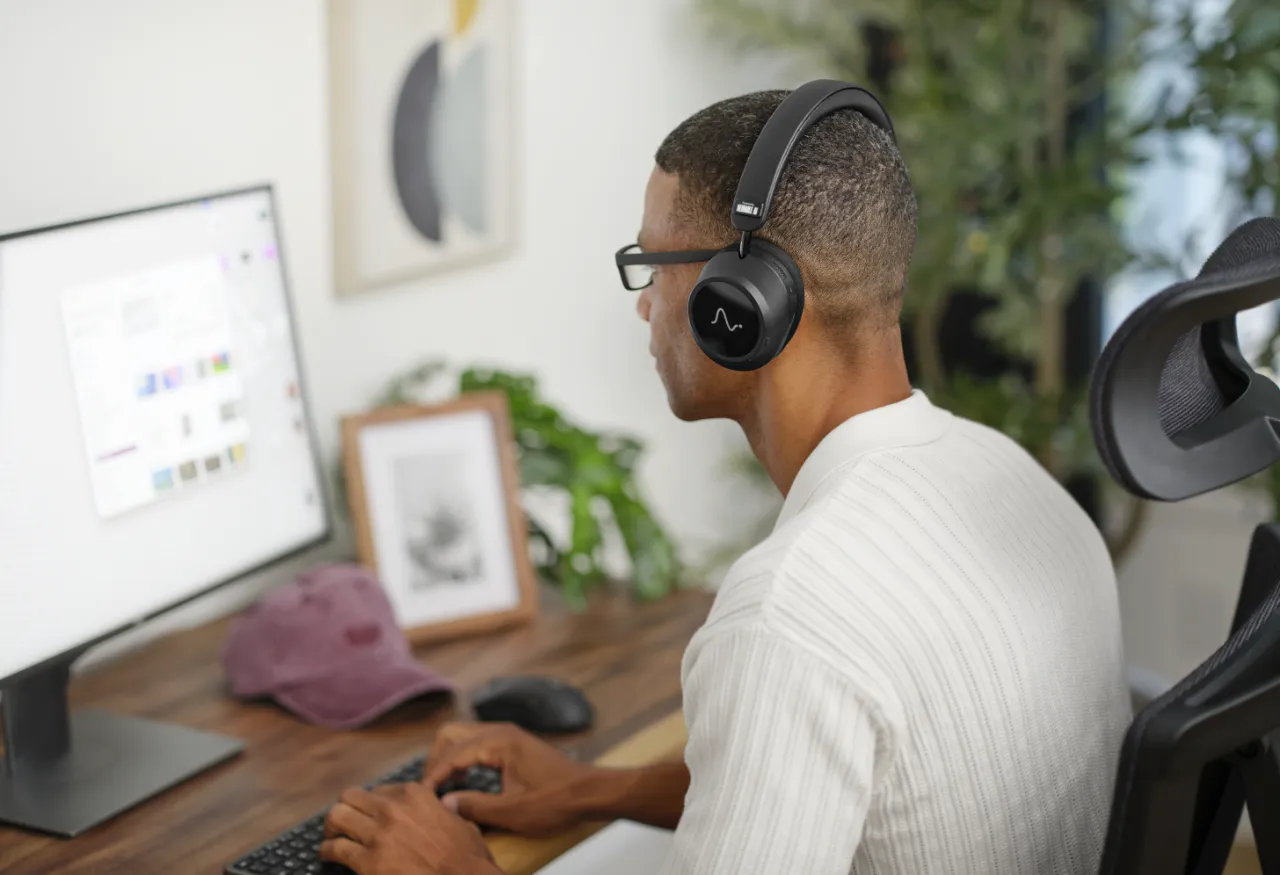
What if your headphones could tell you when you’re losing focus, when your brain needs a break, and when you’re naturally at your cognitive best?
We live in an age where our attention has become one of the most valuable commodities on Earth.
Social media platforms compete to keep us scrolling. Smartphones interrupt us with endless notifications. Algorithms are engineered to capture our curiosity, and now AI has added another layer of information, stimulation and distraction to our already overloaded minds.
We’ve never had more tools to make us productive. Yet somehow, finding the mental clarity to sit down and concentrate on one meaningful task feels harder than ever.
I know this struggle intimately.
I’m an entrepreneur with ADHD, running multiple businesses that involve marketing, travel and coaching. On any given day, I’m juggling client projects, creative ideas, business decisions, emails and a seemingly endless list of things that need my attention.
My ADHD brain loves novelty. I can become completely absorbed in something that fascinates me, entering a state of hyperfocus where hours disappear. But getting into that state deliberately, especially when working on something less stimulating, is a different story.
Over the years, I’ve experimented with meditation, mindfulness, spending time in nature, different productivity systems and various biohacking wearables to improve my ability to concentrate.
These practices have made an enormous difference in my life. Meditation has helped me develop greater awareness of my thoughts, while spending time in nature helps me reset and recover from the constant stimulation of digital life.
But I’m always curious about the next frontier.
Can we use technology not just to measure our physical health, but to understand and improve how our brains function?
That’s what makes the Neurable One (affiliate link), a pair of headphones with built-in brainwave sensors, one of the most fascinating neurotechnology devices I’ve come across in 2026.
Neurable promises something that sounds almost like science fiction: headphones that can monitor your brain activity, recognize when your attention is drifting, and help you develop a better understanding of your mental performance.
The big question is whether they actually work.
And perhaps more importantly, can a device like this help us reclaim our attention from a digital world designed to steal it?
The Attention Crisis: How We Lost Control of Our Minds
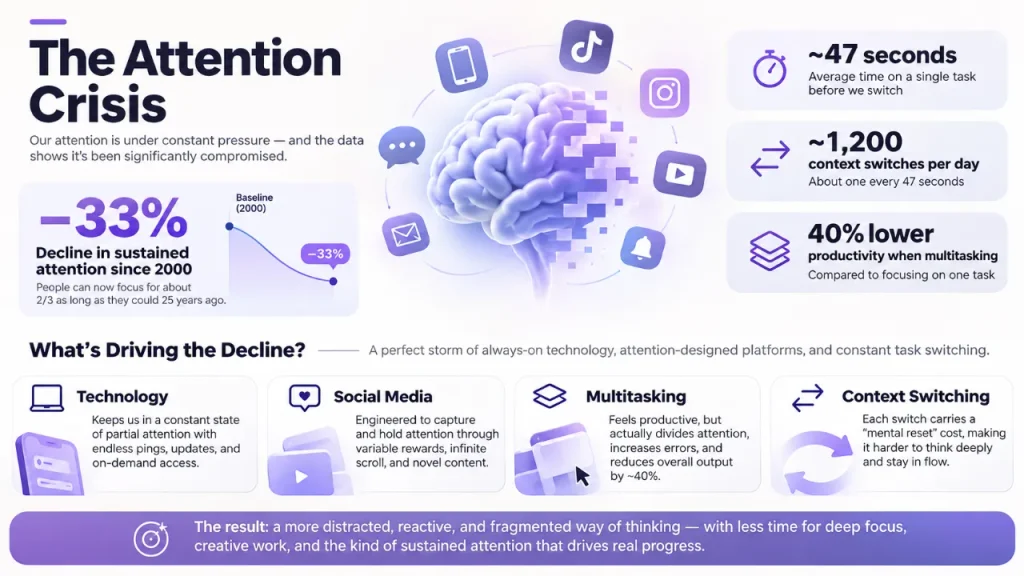
Before getting into the technology, it’s worth understanding the problem Neurable is trying to solve.
Over the past decade, our relationship with technology has fundamentally changed.
The internet used to be somewhere we went to find information. Today, it’s an environment that follows us everywhere, constantly competing for our attention.
Every notification invites us to abandon what we’re doing. Every social media feed offers an infinite stream of novelty. Every recommendation algorithm learns which kinds of content are most effective at keeping us engaged.
Our attention has become the product.
And the consequences go beyond wasting a few minutes scrolling Instagram.
According to research by Dr. Gloria Mark at the University of California, Irvine, the average amount of time people spend attending to a single computer screen before switching has fallen dramatically.
In 2004, researchers measured an average of approximately two and a half minutes. By the late 2010s and early 2020s, that figure had dropped to just 47 seconds.
That’s less than a minute before we switch our attention to something else.
Importantly, this research measures screen switching, not the total capacity of the human brain to concentrate. But it reveals how fragmented our digital working environments have become.
In another study, researchers found that receiving a smartphone notification can disrupt attention even when we don’t pick up the phone.
And research by organizational psychologist Sophie Leroy introduced the concept of attention residue.
When we switch from one task to another, part of our attention often remains attached to the previous task, making it harder to fully concentrate on what comes next.
For entrepreneurs, creators and knowledge workers, this creates a particularly frustrating problem.
Our most valuable work usually requires sustained attention. Yet the tools we rely on to run our businesses are often the same tools that fragment our concentration.
AI adds an interesting paradox.
On one hand, AI can dramatically reduce the time required for research, writing, coding and administrative work. On the other, it creates an endless stream of new possibilities, ideas and information to explore.
For someone with ADHD, that’s a dangerous combination.
I can start the morning intending to finish one important project, discover an interesting new AI tool, follow three related ideas, and suddenly realize that two hours have disappeared.
I’ve been incredibly busy. But have I actually moved forward?
That’s the difference between activity and meaningful progress.
And it’s why I’m increasingly convinced that the ability to direct and sustain our attention may become one of the most valuable skills of the AI age.
The future belongs to people who can combine powerful technology with the increasingly rare ability to think deeply.
What Are the Neurable One Headphones?
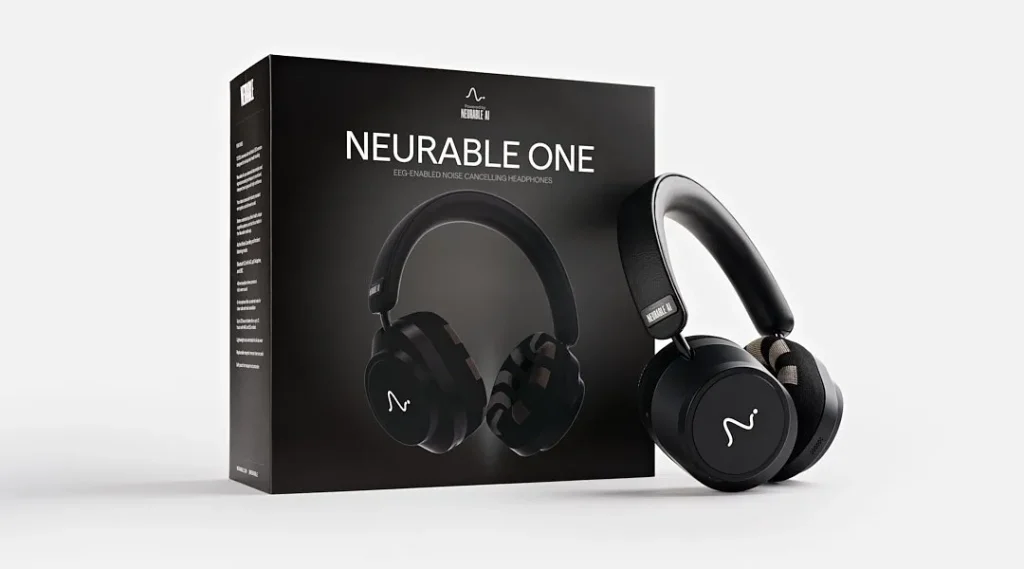
The Neurable One are premium wireless noise-cancelling headphones that incorporate electroencephalography (EEG) technology to monitor electrical activity associated with different cognitive states.
In plain English, they let you listen to music while collecting information about how your brain is functioning.
Developed by Neurable, a neurotechnology company founded out of research at the University of Michigan, the headphones represent more than a decade of work on brain-computer interfaces.
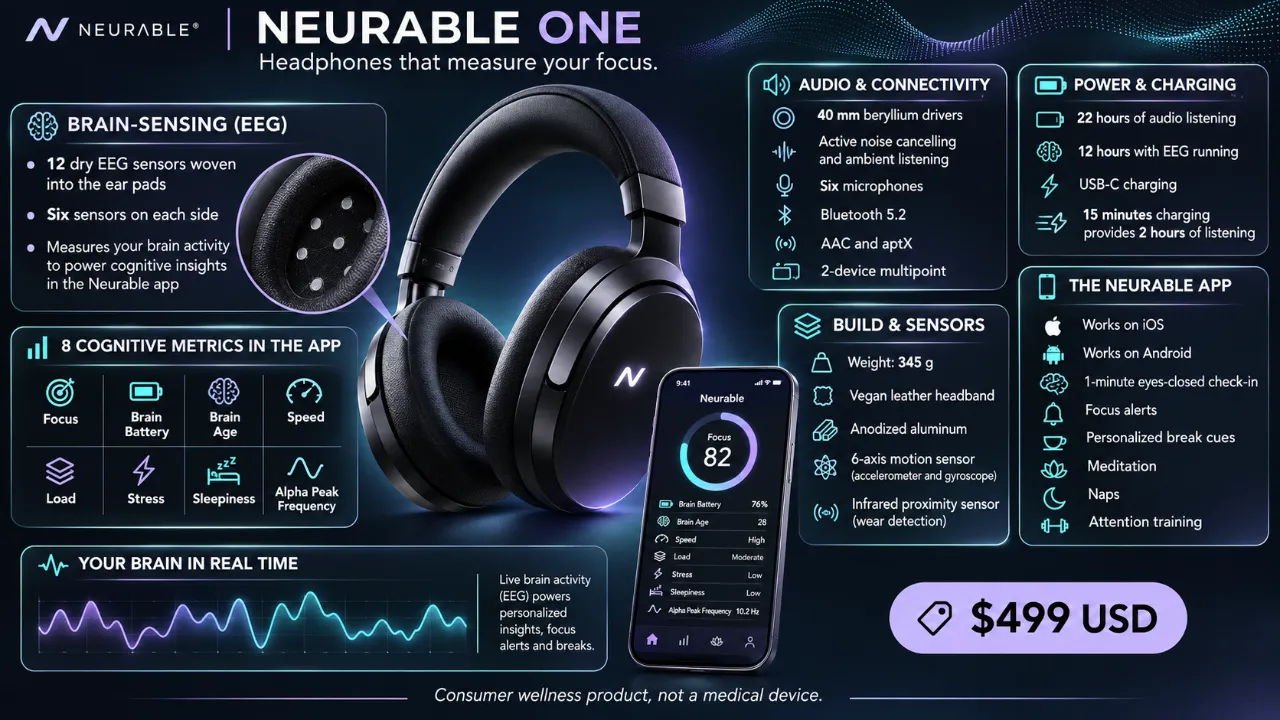
Unlike traditional EEG systems, which typically require specialized equipment and electrodes attached to your scalp, Neurable has integrated 12 dry EEG sensors directly into the headphones’ ear cushions.
Six sensors sit around each ear, collecting electrical signals while you wear the headphones.
AI-powered software processes these signals and translates patterns in brain activity into metrics such as focus, cognitive load, fatigue and stress.
Importantly, the headphones don’t read your thoughts.
They cannot tell what you’re thinking about, what you’re imagining or whether you’re working on something meaningful.
Instead, they analyze brain activity to estimate cognitive states.
Think of them as a fitness tracker for your brain.
Just as a smartwatch tracks your heart rate, sleep and physical activity, Neurable attempts to provide a window into your mental performance throughout the day.
The Neurable One launched in October 2026 at $499, following earlier collaborations with premium headphone manufacturer Master & Dynamic, including the MW75 Neuro.
The biggest difference with the new model is that Neurable now controls both the headphone hardware and software, allowing it to integrate brain tracking more closely into everyday listening.
How Do Neurable One Headphones Work?
The science behind the headphones is called electroencephalography, or EEG.
Every time neurons communicate, they generate tiny electrical signals. When large populations of neurons become active together, some of those signals can be detected from the surface of the head.
Researchers have studied these patterns for more than a century.
EEG is used in neuroscience and clinical medicine to investigate sleep, seizures, attention and other aspects of brain activity.
Different patterns of electrical activity are associated with different cognitive states.
For example, alpha rhythms are often associated with relaxed wakefulness, while changes in other frequency bands can accompany attention, mental effort and drowsiness.
But there isn’t one simple brainwave that means you’re focused.
Attention is a complicated process involving multiple neural networks. EEG patterns also vary depending on the person, the activity and the surrounding environment.
That’s where Neurable’s algorithms come in.
Rather than treating one brainwave frequency as a universal measure of concentration, the system analyzes multiple signals and patterns to estimate changes in your cognitive state.
The headphones also need to distinguish brain activity from interference caused by movement, facial muscles and other sources of electrical noise.
This is especially challenging when the sensors are positioned around the ears instead of across the scalp.
Neurable’s approach is interesting because it brings brain sensing into a device many of us already wear for hours every day.
You don’t need to sit in a laboratory.
You can wear the headphones while writing, reading, studying, working or listening to music.
According to WIRED’s coverage of the Neurable One launch, the latest model supports passive monitoring, meaning you don’t have to remember to start a dedicated focus session every time you want to collect brain data.
There is a one-minute eyes-closed check-in used to establish a reference for certain metrics, but the goal is to make brain monitoring feel as effortless as tracking your steps.
The Eight Brain Metrics: Understanding Your Cognitive Performance
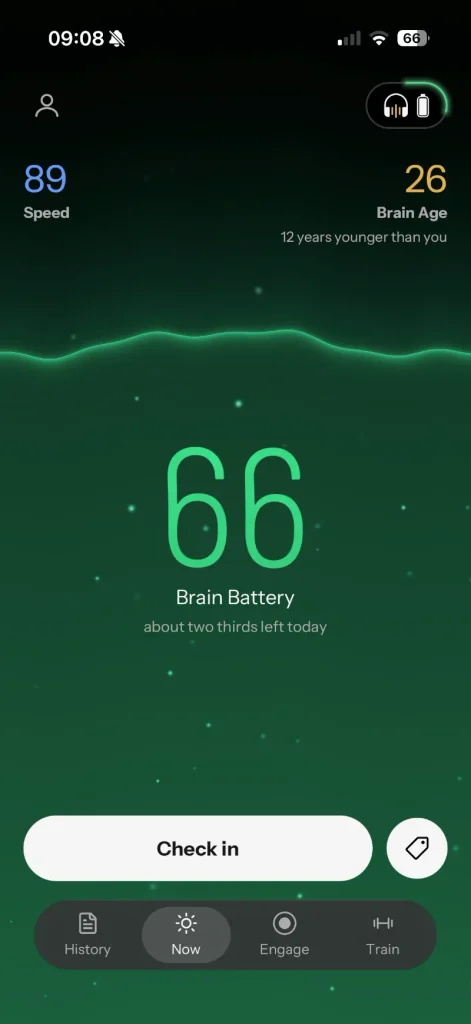
One of the biggest attractions of Neurable One is its companion app, which translates EEG signals into eight cognitive metrics.
Some are designed to help you understand what’s happening right now. Others become more useful as the system collects data over several weeks.
1. Focus: How Well Can You Sustain Attention?
This is the feature that interests me most.
Neurable estimates how steadily you’re maintaining your attention and displays that information as a changing focus score.
During dedicated focus sessions, you can see periods of stronger concentration and moments when your attention begins to drift.
When the system detects distraction, it can provide an audio cue to encourage you to return to what you’re doing.
I find this idea fascinating because one of the biggest challenges with ADHD is often recognizing when your attention has wandered.
You might open a browser tab for a legitimate reason, follow an interesting link, and only realize ten minutes later that you’ve completely forgotten what you were originally doing.
Imagine receiving a gentle reminder when your attention starts slipping.
That’s the potential value of real-time neurofeedback.
Instead of discovering you’ve lost focus after wasting twenty minutes, you could become aware of the shift much sooner.
Of course, the system doesn’t know whether you’re working on your business or scrolling through entertaining videos. You can be highly attentive to something completely unproductive.
That’s an important distinction: concentration isn’t the same thing as choosing what deserves your concentration.
2. Brain Battery: How Much Mental Energy Do You Have Left?
Many of us are familiar with the idea of tracking a body battery or readiness score through fitness wearables.
Neurable brings a similar concept to cognitive performance.
Its Brain Battery metric estimates your remaining mental capacity throughout the day based on patterns in your brain activity.
The idea is that you can begin recognizing when your brain is ready for demanding work and when it’s starting to become fatigued.
This could be particularly useful for entrepreneurs who have some flexibility in how they structure their schedules.
Instead of forcing yourself through a complex creative task when you’re mentally exhausted, you might discover that a short walk, meditation session or restorative break is a better investment.
However, Brain Battery is an algorithmic estimate, not a literal measurement of how much energy your brain has left.
It’s best treated as feedback to compare against your experience rather than an unquestionable verdict on your cognitive capacity.
3. Cognitive Load: How Hard Is Your Brain Working?
Not all concentration requires the same effort.
Writing an important proposal, learning a new skill and answering routine emails can place very different demands on your brain.
Neurable’s Load metric attempts to estimate how much mental effort you’re expending.
This is particularly interesting because high effort doesn’t necessarily mean high productivity.
Sometimes we’re working incredibly hard because a task is unnecessarily complicated, we’re distracted, or we’re trying to do too many things simultaneously.
Over time, comparing cognitive load with different activities could help identify which kinds of work are naturally demanding and which systems might need simplifying.
4. Cognitive Speed: When Are You Mentally Sharpest?
Neurable’s Speed metric estimates aspects of cognitive processing performance based on your brain signals.
It could potentially help reveal patterns in when you feel mentally sharp.
Some people do their clearest thinking early in the morning. Others find their creative energy peaks in the afternoon or evening.
For me, this raises an interesting possibility: using personal cognitive data to design a more intelligent workday.
Instead of organizing every day around meetings, notifications and other people’s priorities, we could begin protecting the hours when our minds are functioning at their best.
5. Stress: Understanding Mental Strain
Neurable also estimates patterns associated with stress.
This could be useful for recognizing how different activities affect your mental state.
Perhaps meetings create more cognitive tension than you realize. Maybe taking a walk or listening to calming music changes your readings.
I’m especially interested in comparing stress before and after meditation or spending time outdoors.
The important caveat is that EEG-based stress scores are indirect estimates. They aren’t a definitive measurement of emotional stress or a clinical assessment.
6. Sleepiness: Recognizing When Your Brain Needs Rest
Sometimes we’re not distracted because we’re lazy or lack discipline.
We’re simply tired.
Neurable attempts to detect brain activity associated with drowsiness, potentially helping distinguish between a difficult task and a brain that’s running out of steam.
For someone who tends to push through fatigue, this could be a useful reminder that recovery is part of performance.
7. Brain Age: Tracking Long-Term Cognitive Patterns
Brain Age is one of the more ambitious metrics.
Neurable uses patterns in your EEG data to estimate a brain-age-related score that can be tracked over time.
It’s an intriguing idea, especially for people interested in cognitive longevity.
However, this is also one of the features I’d approach most cautiously.
Brain Age is not a medical diagnosis, and a changing score doesn’t automatically mean your brain is biologically becoming younger or older.
Neurable itself indicates that this metric needs weeks of observations to become more meaningful.
I’d regard it as an experimental trend rather than an established measure of brain health.
8. Alpha Peak Frequency: A Window Into Your Resting Brain Rhythms
Alpha Peak Frequency measures the dominant frequency of your alpha rhythm while you’re resting with your eyes closed.
Researchers have studied relationships between alpha peak frequency, aging and aspects of cognitive function.
Neurable suggests this could become a useful longer-term indicator of cognitive health.
It’s an exciting area of research, although interpreting changes in an individual’s alpha frequency is much more complicated than simply assuming a higher number means a better brain.
This is another metric I’d watch over months rather than obsessing over day-to-day fluctuations.
Can Neurable One Actually Improve Your Focus?
Here’s the million-dollar question.
It’s one thing to measure concentration. It’s another thing to actually improve it.
A fitness tracker can tell you that you haven’t exercised enough, but it won’t make you physically fit.
The same principle applies to brain tracking.
Neurable doesn’t magically make you focused. It gives you feedback that may help you develop better habits for sustaining attention.
And that distinction matters.
Real-Time Feedback Builds Self-Awareness
One of the foundations of mindfulness meditation is learning to recognize when your attention wanders.
You focus on your breath. Your mind begins thinking about something else. Eventually, you notice the distraction and gently return your attention to the breath.
Over time, you’re practicing awareness and attentional control.
There’s scientific support for this approach. A meta-analysis of 111 randomized controlled trials involving more than 9,500 participants found that mindfulness-based interventions produced small-to-moderate improvements across several areas of cognitive functioning, including sustained attention and working memory accuracy.
Neurable uses technology to introduce a similar feedback loop.
Instead of relying entirely on your own awareness, the headphones attempt to recognize changes in attention and signal when you might need to refocus.
It’s essentially a technologically assisted form of attention training.
That doesn’t mean EEG feedback and meditation work through identical mechanisms, but they share an interesting principle: becoming aware of your mental state creates an opportunity to respond differently.
You Can Discover Your Personal Focus Patterns
One interesting observation from early independent reporting on Neurable’s headphones is that focus readings can fluctuate substantially during everyday activities.
This is something I’ve experienced in my own work.
There are days when I get more meaningful work done in two uninterrupted hours than I do in an entire afternoon of switching between projects.
The value of Neurable could be in helping people recognize those patterns more clearly.
Maybe your best creative work happens between 9 and 11 a.m.
Maybe you concentrate more effectively after exercising.
Maybe listening to instrumental music improves your ability to sustain attention, while podcasts distract you.
The headphones could give you another way to test those hypotheses against your own data.
Smarter Breaks Instead of Pushing Through Fatigue
Most productivity systems rely on time.
The Pomodoro Technique, for example, commonly recommends working for 25 minutes and then taking a short break.
But our brains don’t always operate on predictable schedules.
Sometimes you can stay deeply engaged for an hour. Other times you’re mentally exhausted after twenty minutes.
Neurable attempts to recommend breaks based on estimated cognitive fatigue rather than an arbitrary timer.
This could help people avoid the frustrating experience of sitting in front of a computer, technically working, but making almost no progress.
The aim isn’t necessarily to spend more hours working.
It’s to make better use of the hours when you’re capable of meaningful concentration.
What Does the Research Actually Show?
There are encouraging early findings, but they need perspective.
Neurable has reported preliminary research using earlier versions of its EEG technology that suggests improvements in attention and reductions in perceived burnout.
In WIRED’s October 2026 reporting, the company referenced earlier research conducted with the Mayo Clinic, claiming a 30% increase in focus compared with other productivity approaches and approximately a 10% reduction in end-of-day burnout.
Those figures are company-reported findings, not independent confirmation that the new Neurable One delivers the same benefits.
Neurable also published a small observational analysis of 15 frequent users in October 2026.
Ten of the 15 users improved their focus-efficiency scores over a month.
The average score increased from 67.5% to 72.1%.
That’s interesting, but it isn’t definitive proof.
The sample was small, there was no randomized control group, and some improvement may reflect people becoming familiar with the device or normal variation in initial scores.
Most importantly, the new Neurable One only launched recently, and evidence specifically validating its long-term ability to improve everyday productivity remains limited.
For now, I think the most reasonable conclusion is that Neurable’s technology has genuine scientific foundations and promising early results, but its ability to produce lasting improvements in focus is not yet conclusively established.
Neurable One and ADHD: Could These Headphones Help?
As someone with ADHD, this is naturally the part I’m most interested in.
ADHD isn’t simply an inability to pay attention.
It’s often a difficulty regulating attention, managing distractions, initiating tasks and directing mental energy consistently.
For many people with ADHD, attention is strongly influenced by interest, novelty, urgency and immediate rewards.
That’s why someone might struggle to complete a routine administrative task but become completely absorbed in a creative project for hours.
Neurable could be particularly interesting for people who struggle with noticing when their attention has wandered.
The combination of noise cancellation, real-time feedback and cognitive pattern tracking might help create a more supportive environment for focused work.
I see three potential benefits.
First, the headphones could make distraction more visible. If you can recognize your attention drifting sooner, you have an opportunity to return to the task before getting completely sidetracked.
Second, they could help identify your best working conditions. You might discover that certain times of day, environments or types of audio make concentration easier.
Third, they could encourage better recovery habits. Many entrepreneurs with ADHD experience cycles of intense focus followed by exhaustion, particularly when juggling multiple commitments.
Knowing when to take a break could be useful.
But there’s an important scientific limitation.
A major systematic review and meta-analysis published in JAMA Psychiatry evaluated 38 randomized clinical trials involving 2,472 participants.
The researchers found that neurofeedback did not produce meaningful overall improvements in ADHD symptoms when assessed using more rigorous, blinded measures.
Some smaller benefits were found with specific standardized neurofeedback protocols, particularly for processing speed, but the overall evidence wasn’t strong enough to recommend neurofeedback as a stand-alone ADHD treatment.
That research examined neurofeedback more broadly, not Neurable One specifically.
And that’s an important distinction.
Neurable One is not an ADHD treatment, and there is not yet strong clinical evidence that these headphones improve ADHD symptoms.
They don’t replace established approaches such as medication when appropriate, behavioral strategies, coaching, sleep management or other evidence-based care.
I would consider them a potentially useful supplementary tool for experimentation and self-awareness, not a solution to ADHD itself.
And for some people with ADHD, the constant availability of another performance metric could become its own distraction.
The point should be to spend less time worrying about focus and more time actually focusing.
How Their Audio Biofeedback Technology Works
One of Neurable’s most interesting features is its real-time audio biofeedback technology, which combines music, brainwave monitoring and neurofeedback to help you become more aware of your concentration and train your attention.
During a focus session, the headphones continuously monitor your brain’s electrical activity using built-in EEG sensors. The app analyzes these signals to estimate your level of focus and adjusts the volume of background audio in response.
The feedback works through a simple sequence:
- Start a Focus Session: The headphones use 12 built-in EEG sensors to monitor your brain activity while you work.
- Your focus increases: As Neurable detects stronger concentration, the background audio track becomes louder, providing positive feedback.
- Your attention drifts: When your measured focus decreases, the audio becomes quieter, giving you a subtle signal that your concentration has slipped.
- You refocus: As you return your attention to the task and your focus score improves, the audio becomes louder again, reinforcing the feedback loop.
I find this fascinating because music has always been one of my favorite tools for entering a creative flow state. Ambient soundscapes and repetitive instrumental music can help me tune out distractions and settle into deeper concentration.
What makes Neurable different is that the sound responds to your estimated cognitive state. Instead of checking another screen, you can hear your focus changing in real time.
Over time, this feedback could help you become more aware of what sustained concentration feels like and recognize distractions sooner.
While more independent research is needed to establish whether this kind of neurofeedback produces lasting improvements, the idea of using sound to train your attention rather than compete for it is one of Neurable One’s most compelling features.
The Headphones Themselves: Sound, Comfort and Battery Life
It’s easy to become so interested in the brain-tracking technology that you forget these are also supposed to be headphones.
Fortunately, Neurable has put considerable attention into the audio hardware.
According to the official Neurable One specifications, they feature 40 mm beryllium drivers, active noise cancellation, an ambient listening mode and six microphones for calls.
They support Bluetooth 5.2, including multipoint connectivity that lets you pair a computer and smartphone simultaneously.
For someone who works remotely, that’s a practical feature.
You can move between meetings, music and focused work without constantly reconnecting your headphones.
The physical design uses anodized aluminum, vegan leather and specialized ear cushions containing the EEG sensors.
At approximately 345 grams, they’re not exceptionally lightweight, but they’re comparable to other premium over-ear headphones.
Early hands-on coverage has generally been positive about the concept and integration, although the newer model hasn’t yet accumulated the extensive independent audio testing of more established headphones.
That’s worth considering if sound quality or noise cancellation is your top priority.
Battery Life
Neurable advertises up to 22 hours of ordinary audio playback.
With EEG monitoring running, battery life drops to approximately 12 hours.
That’s enough for a typical workday, although frequent charging may be necessary for people who use the brain-tracking features extensively.
A 15-minute charge provides approximately two additional hours of use.
One practical limitation is that EEG monitoring stops while charging and when battery levels fall below 20%.
For a device designed to monitor cognitive patterns throughout the day, keeping it charged is part of the routine.
The Price
At $499, Neurable One sits firmly in the premium headphone category.
You’re paying for both high-end audio hardware and an emerging form of consumer neurotechnology.
If your only goal is listening to music or blocking noise, there are plenty of excellent headphones available for less.
But if you’re fascinated by cognitive performance, brain-computer interfaces and the ability to monitor your own attention, the additional features make the price easier to justify.
Neurofeedback, Meditation and Training Your Attention
What excites me most about Neurable isn’t necessarily the possibility of getting more work done.
It’s the possibility of using neurotechnology to develop greater awareness of how our minds function.
I’ve been meditating for years, and one of the most important lessons I’ve learned is that attention is trainable.
When you meditate, you begin to recognize how frequently your mind wanders into thoughts, memories, plans and worries.
You also start noticing how much mental energy is consumed by internal noise.
For me, meditation has been one of the most valuable tools for learning to step outside the constant stream of thoughts and return to the present moment.
Spending time in nature has a similar restorative effect.
When I’m hiking in the mountains, walking through a forest or simply sitting somewhere beautiful without my phone, I notice a different quality of attention emerging.
There’s less pressure to respond, perform or consume information.
My awareness becomes more spacious.
Neurable interests me because it offers another way to explore these shifts.
The app includes meditation and recovery features alongside its focus-tracking tools.
Imagine comparing your cognitive patterns before and after a twenty-minute meditation.
Or exploring whether a restorative break changes your afternoon mental fatigue.
You could even compare different kinds of meditation, such as focused breathing, open awareness and guided practices.
These wouldn’t be laboratory-grade experiments, and the resulting metrics shouldn’t be treated as proof that one practice is universally superior.
But as a personal learning tool, the possibilities are fascinating.
I think the future of biohacking will increasingly involve this combination of ancient contemplative practices and modern measurement technology.
The goal shouldn’t be to turn meditation into another performance competition.
It’s to better understand our minds and develop a healthier relationship with attention.
What I Like About Neurable One
There are several reasons I think this is one of the most interesting consumer neurotechnology products of 2026.
It makes brain tracking practical. Instead of requiring a specialized headset or complicated preparation, the sensors are integrated into headphones you can wear while doing everyday activities.
It focuses on actionable feedback. Rather than simply presenting abstract brainwave graphs, the app attempts to translate cognitive data into practical suggestions about focus and recovery.
It encourages greater awareness of attention. For someone who struggles with distraction, learning to recognize patterns of cognitive performance could be genuinely useful.
It combines multiple tools in one device. Noise cancellation, music, cognitive monitoring and guided recovery sessions are integrated into a single wearable.
It opens the door to personal experimentation. You can explore how work schedules, breaks, meditation and other habits relate to your cognitive patterns.
And perhaps most importantly, Neurable is attempting to build technology that helps us become more conscious of our attention rather than simply capturing more of it.
In an industry dominated by engagement metrics, that’s a refreshing direction.
What I Don’t Like About Neurable One
Despite the excitement, there are meaningful limitations.
The Science Is Still Emerging
The underlying EEG technology is well established, but translating around-ear brain signals into reliable everyday focus scores is a much newer application.
There is promising research, but the evidence that Neurable One can consistently produce lasting improvements in attention or productivity is still developing.
Brain Metrics Aren’t Perfect
A focus score can be influenced by factors beyond whether you’re doing meaningful work.
EEG recordings are also vulnerable to movement, muscle activity and sensor-contact issues.
It’s important not to mistake a sophisticated estimate for a perfect measurement.
The Price Is High
At $499, these headphones are expensive compared with simpler productivity tools.
You could purchase excellent noise-cancelling headphones and still have money left for meditation classes, coaching or other approaches to improving focus.
Privacy Deserves Attention
Brain data is unusually personal.
According to WIRED’s reporting on Neurable’s data practices, Neurable says it doesn’t sell brain recordings or use them for advertising.
The company also confirms on its product information page that raw EEG recordings are processed and stored on its servers.
That means users should understand the privacy policy and account-deletion process before committing to continuous cognitive monitoring.
Productivity Tracking Can Become Another Obsession
This might be my biggest philosophical concern.
We’re already surrounded by apps that measure our steps, sleep, recovery, productivity and daily habits.
Do we really need another score telling us whether we’re performing well enough?
For some people, the information may be empowering.
For others, it could introduce unnecessary pressure.
The healthiest use of Neurable would be to learn from the data without becoming dependent on it.
Who Should Buy Neurable One?
I think these headphones will appeal most to people who are already interested in understanding and improving their cognitive performance.
Entrepreneurs, writers, developers, students, researchers and other knowledge workers could find the focus-tracking features particularly interesting.
They may also appeal to people with ADHD who are curious about developing greater awareness of their attention patterns, provided they understand the device isn’t a medical treatment.
And for biohackers who enjoy experimenting with new technology, Neurable represents an exciting step toward more accessible brain-computer interfaces.
On the other hand, I wouldn’t recommend spending $499 if you’re simply looking for a quick fix for procrastination.
The fundamentals still matter.
Getting enough sleep, exercising regularly, reducing digital distractions, spending time outside and practicing sustained attention are likely to deliver more dependable benefits than buying another gadget.
Neurable works best as an additional layer of feedback built on top of those habits.
My Verdict: Can Neurable One Help You Reclaim Your Focus?
I think Neurable One represents an important step in the evolution of wearable technology.
We’ve spent years learning how to track our physical health through heart rate monitors, fitness trackers, sleep sensors and smartwatches.
Now we’re beginning to develop consumer devices that can provide information about our cognitive performance.
That’s a significant shift.
But the question that interests me isn’t just whether these headphones can help me become more productive.
It’s whether technology like this can help us develop a healthier relationship with our own minds.
We’ve spent the past decade surrounded by increasingly sophisticated systems designed to influence where we direct our attention.
Social media companies understand the psychology of distraction. Recommendation algorithms have become extraordinarily good at predicting what will keep us engaged.
And AI is making digital experiences even more personalized, interactive and difficult to ignore.
What if the next generation of technology helped us reverse that relationship?
What if instead of designing technology to capture more attention, we designed it to help people become more aware of their attention?
That’s the promise I see in Neurable.
Not that a pair of headphones will magically transform you into a productivity machine.
Not that measuring your brainwaves will automatically make you smarter.
But that greater awareness of your cognitive patterns might help you make better decisions about how you work, when you rest and what deserves your attention.
Is Neurable One the Antidote to Our Attention Crisis?
Not by itself.
The real antidote is learning to take ownership of our attention.
That means creating space for deep work, reducing unnecessary distractions, developing mindfulness and remembering that our time and mental energy are finite resources.
It also means recognizing that being constantly busy isn’t the same thing as living meaningfully.
For me, the goal of improving focus has never been to squeeze more productivity out of every waking hour.
It’s to create more freedom.
The freedom to build businesses around my interests, spend more time in nature, travel, create meaningful experiences and be fully present in the moments that matter.
If technology can help me accomplish meaningful work in less time, that’s a win.
And if it can help me recognize when it’s time to close the laptop and go for a walk in the mountains, that’s an even bigger one.
My verdict: Neurable One is one of the most compelling neurotech wearables of 2026, with promising potential to help people understand and manage their attention. But its long-term focus benefits still need stronger independent validation.
It’s a tool for self-awareness, not a cure for distraction.
And perhaps the greatest promise of brain-tracking technology isn’t helping us do more.
It’s helping us become more intentional about what we choose to pay attention to.
In a world where everyone is competing for our attention, learning to reclaim it might be the ultimate form of freedom.

I believe the future of education starts with helping people find their "zone of genius" so they can develop their uniquely human ability to create meaning, connection and community (that A.I. can't replicate).
I'm also big on completely unplugging from tech to recharge on nature retreats and trekking adventures. That led me to start my most recent company Sacred Treks.
- 10 Innovative New Biohacking Wearables I’m Excited For In 2027 - November 9, 2026
- Neurable One Review: Can These EEG Headphones Help You Reclaim Your Focus? - November 9, 2026
- 40 Best Health & Wellness Conferences Happening In 2026/2027 - November 8, 2026