

Our attention is under attack. Smartphones, social media feeds and now AI tools are all competing for the same few seconds of focus, and most of us are losing.
The numbers match what it feels like. UC Irvine professor Gloria Mark has measured how long people stay on one screen before switching since 2004. Back then, it was about two and a half minutes. In studies from 2016 to 2020, the average had dropped to 47 seconds.
Phones make it worse. Americans check their phones about 186 times a day, according to the latest 2026 survey. That’s roughly once every five minutes while awake.
I know this problem intimately. I’m an entrepreneur with ADHD, running multiple businesses at once, and my attention gets pulled in a dozen directions each day. So I’m always testing new neurotech and biohacking devices to see what actually works for boosting focus and energy. Over the years, I’ve tried many things to hack the flow state, from cold plunges, breathwork, binaural beats, supplements, long mindful walks in the forest, to a drawer full of brain gadgets.
Some of it worked. A lot of it didn’t.
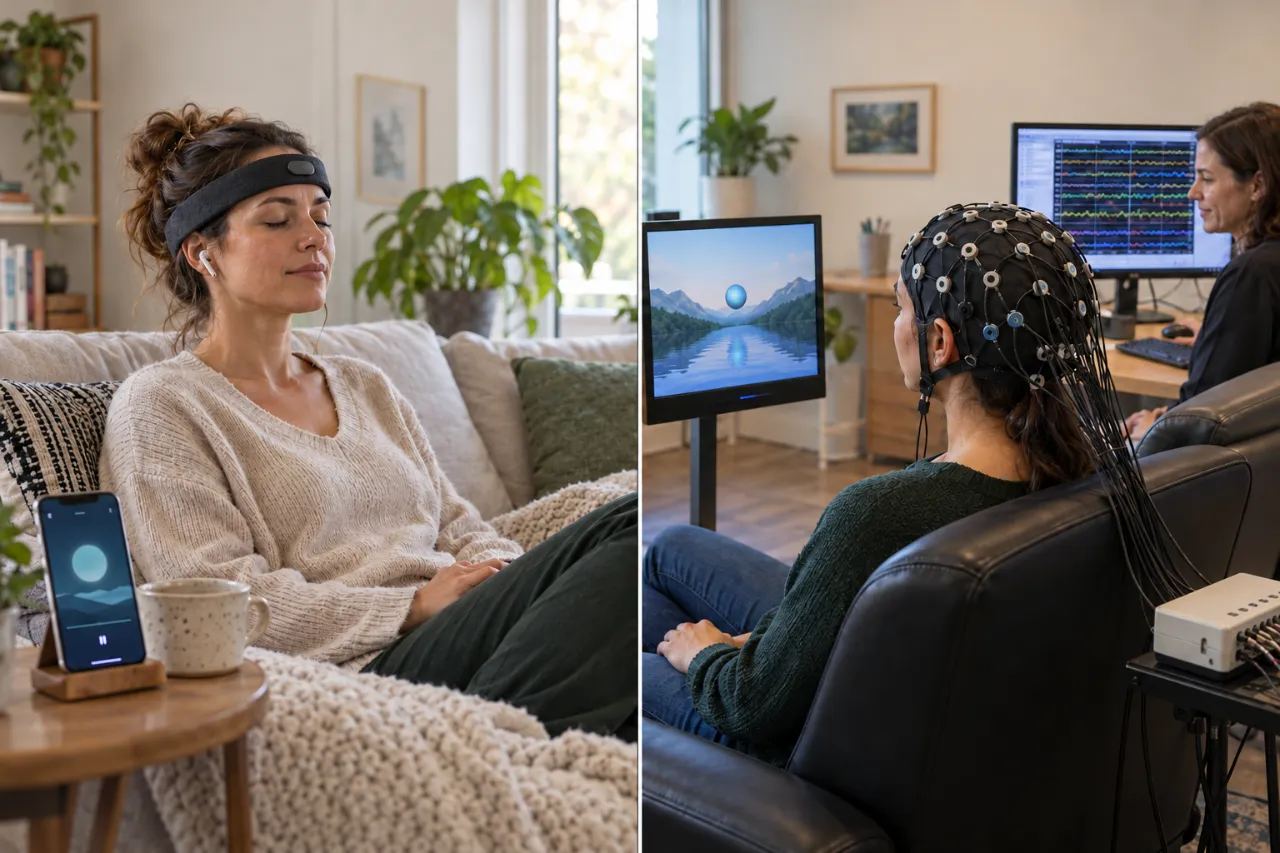
Home neurofeedback training turned out to be one of the most useful things I’ve tried. Seeing my brain activity in real time, and learning to shift it, changed how I think about focus.
But there was always a catch. Home neurofeedback meant stopping work, putting on a headset and sitting through a session. The training happened in one place, and the distraction happened somewhere else.
EEG headphones fix that. You wear them while you work. They notice when your focus slips, when you’re getting tired and when you’re in the zone. Getting that feedback in the middle of a real workday, right when you’re getting distracted, is a huge leap forward for anyone trying to get into a flow state more often.
They aren’t medical devices, and the research on neurofeedback is still mixed. A 2025 JAMA Psychiatry review of 38 trials found no clear benefit for ADHD symptoms when raters didn’t know who got the real treatment. So I treat these headphones as a mirror for my habits, not a cure. Sleep, daylight, movement and time outside still matter more than any gadget.
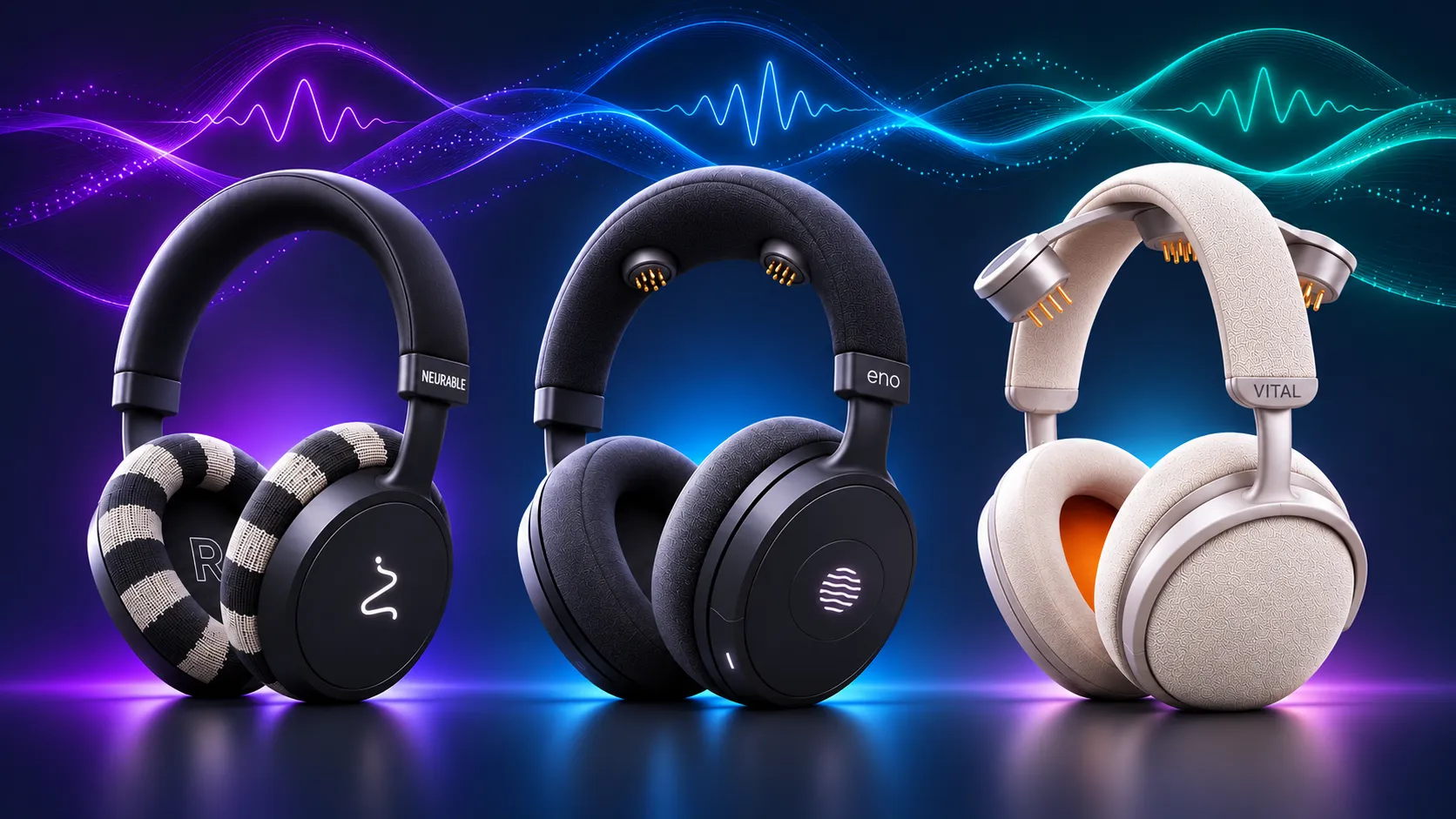
This guide covers the three EEG headphones I think are worth knowing about right now: the Neurable One, Enophones and Vital Neuro. The app gets its own section for each one, because the hardware is only as useful as the UX and design of the app that reads it.
Quick comparison of the EEG smart headphones
Affiliate disclosure: Some links in this article may be affiliate links. If you purchase through them, I may earn a commission at no extra cost to you. This helps support DIY Genius and does not affect my recommendations.
| Neurable One | Enophones | Vital Neuro | |
|---|---|---|---|
| Main job | Tracks focus and mental fatigue | Plays brain-responsive audio | Runs neurofeedback sessions |
| EEG sensors | 12, woven into the ear pads | 4 (A1, C3, C4, A2) | 3 gold-plated sensors |
| Price | $499 | $399 | About $495 plus app subscription |
| Battery with EEG on | About 12 hours | 8 to 10 hours (my test) | About 8 hours |
| App rating (iOS) | 4.8 from 93 ratings (previous app) | 2.9 from 22 ratings | 4.8 from 44 ratings |
| Best for | Founders who want data on their workday | Music lovers who use sound to shift state | Stress, sleep and anxiety relief |
1. Neurable One
Best for: founders and knowledge workers who want hard data on when they focus best and who already wear headphones most of the day.
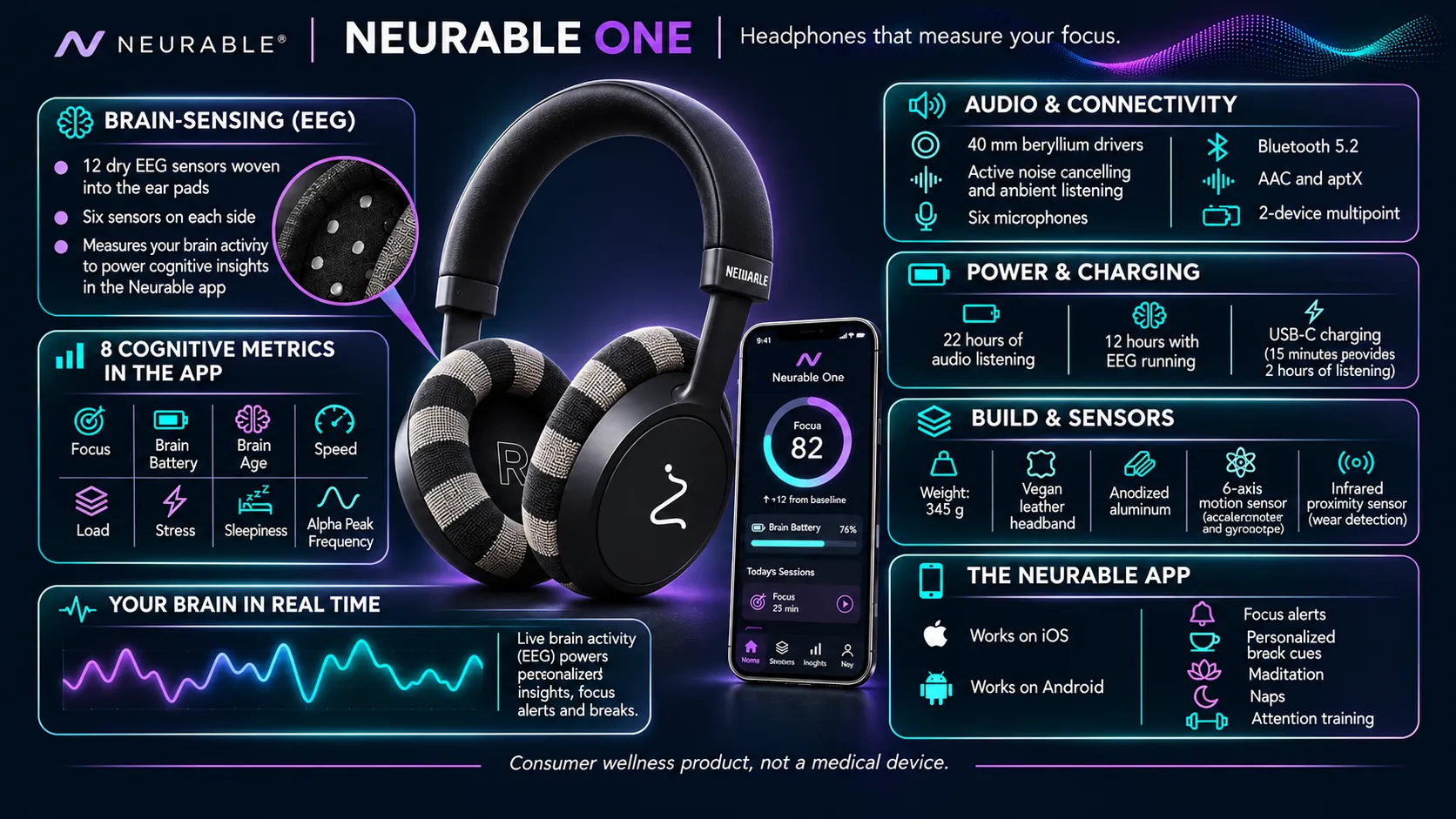
Neurable launched the One on October 1, 2026 (here’s my full Neurable One review). It replaces the MW75 Neuro headphones they built with Master & Dynamic. This time, Neurable controls the whole product: headphones, sensors, firmware and app.
Twelve EEG sensors are woven into the nylon ear pads. You don’t see them, and there are no pins pressing on your scalp. While they can feel a little heavy with prolonged use, they are the most comfortable EEG headphones because they don’t have metal pegs touching your scalp.
The big change from the MW75 Neuro is passive tracking. The older model only recorded during focus sessions you started in the app. The Neurable One records whenever you wear it with the app open, which Neurable calls Brain Data Banking. You start your day with a one-minute, eyes-closed measurement, and after that it runs in the background while you work.
Neurable’s CEO, Ramses Alcaide, has worked on brain-computer interfaces for more than a decade. The company says its AI is trained on a large set of real-world EEG data, which helps it clean up noisy signals from dry sensors. Neurable’s own 20-person study with the earlier MW75 found 67% of users had better focus. That leaves a third who didn’t, and WIRED reported that Neurable hasn’t published new research on the One itself (via The Gadgeteer).
The headline new metric is Alpha Peak Frequency (APF), the speed of your strongest resting brain rhythm. It tends to fall with age, and Neurable compares it to heart rate variability for the brain. Long-term metrics take about a week to calibrate, and Alcaide told IEEE Spectrum that a stable APF reading needs weeks to months of data.
Pros
- Most polished hardware of the three, with sensors hidden in the ear pads
- Passive tracking, so you don’t have to remember to start a session
- Well-designed iOS and Android app (their new app has just launched though)
- Premium audio: 40 mm beryllium drivers, ANC, transparency mode, six mics, multipoint Bluetooth, aptX and AAC
- You can switch off EEG and use them as normal headphones
- Priced the same as the Bose QuietComfort Ultra and Sony WH-1000XM6 class
Cons
- EEG cuts battery from 22 hours to about 12, and EEG stops below 20% battery and while charging
- Needs a week or more before long-term metrics mean much
- Fit and hair can block a clean signal
- No published research on this exact model yet
- One-year warranty and a soft pouch at this price
- It tracks and nudges, but doesn’t do much active brain training yet
The Neurable app
iPhone app: Neurable (4.7/5 ⭐)
Android app: Neurable (No rating)
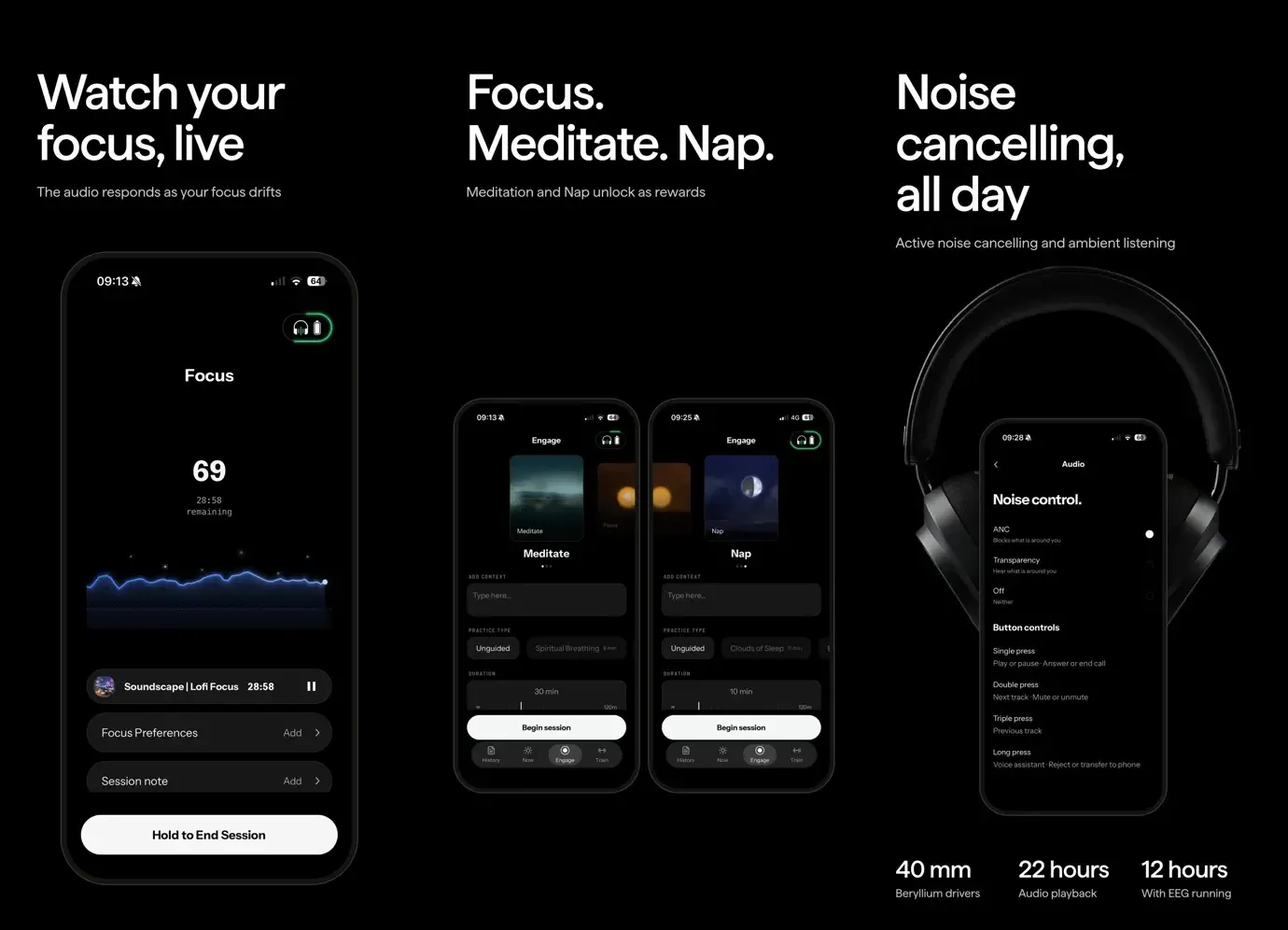
The app tracks eight metrics: focus, cognitive load, speed, stress, sleepiness, Alpha Peak Frequency, Brain Age and Brain Battery. Each one is compared against your own history, not an average person. Brain Battery is a software estimate built from sleepiness, stress and cognitive load, not a direct measurement.
You also get Smart Brain Breaks when fatigue builds, plus weekly and monthly reports.
What app users say:
- The previous Neurable app (for the MW75 Neuro LT) held 4.8 stars from 93 ratings on the US App Store.
- Reviewers say focus scores match how focused they felt, and break reminders send them back to work refreshed.
- Several wanted more long-term features, which the One now adds.
- Earlier versions had headset connection and session sync bugs. Neurable says later updates fixed them.
What reviewers of the One say:
- Gear Diary liked that the app shows a dash instead of a fake number when the signal is poor. Some app features stay locked during the first weeks of ownership.
- IEEE Spectrum’s tester was often asked to adjust the fit, even with hair moved away. Her Brain Battery sat around 50 to 60% most days, and she found the distraction nudges only sometimes useful.
2. Enophones
Best for: creatives who already use music, binaural beats or isochronic tones to get into flow and want sound that adapts to their brain.
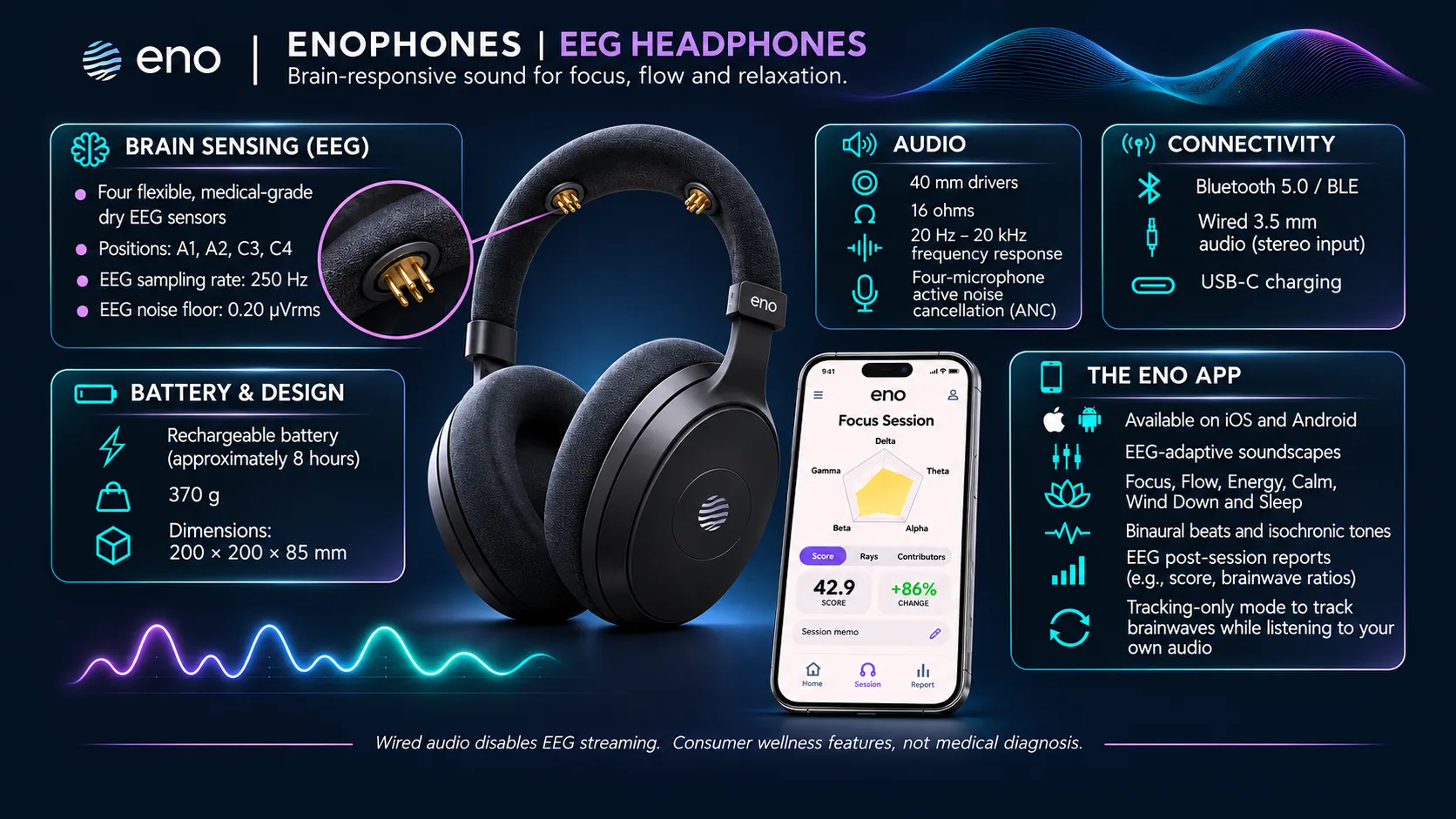
Enophones started in Montreal as a crowdfunded “Fitbit for the brain.” The original startup ran out of money, and Moonshot LA now runs the product and the eno app. I’ve used them for a long time (here’s my full Enophones review), and they’re the most music-first headphones that integrate brainwave entrainment.
They use four sensors. Two sit at the ears (A1 and A2). Two pin sensors on the headband sit at C3 and C4, over the central part of your scalp near areas involved in sustained attention. These pins are the downside of Enophones because they have to touch your scalp to get a good reading and I usually find them uncomfortable after a few hours of wearing them.
Enophones combine brainwave entrainment with neurofeedback. The tracks are designed around target frequencies, like alpha and theta for flow. Then the audio changes in real time based on your EEG, so the music rewards you for moving toward the state you picked. I used to play 10 Hz alpha tracks for writing and video editing with no idea whether my brain was shifting. Enophones close that loop.
The company has published a white paper citing EEG research on flow and creativity but I couldn’t find it online. Entrainment has weaker evidence behind it than neurofeedback but it works great for some people. Overall, they could use a redesign of the sensors, which haven’t changed since they launched in 2022, because the Neurable One’s innovative new sensor technology is vastly superior.
Pros
- Largest library of brain-responsive audio of the three
- Sound by Onkyo, with ANC and talk-through modes
- Cheapest option, at $399 when last listed
- Long battery life in my testing (8 to 10 hours)
- Pins can be removed to use them as normal headphones
Cons
- Weakest app rating and frequent EEG connection complaints
- Slow or missing customer support, according to many reviews
- Pin sensors can be uncomfortable and need adjusting to get a clean read
- Data and reporting are thin compared with Neurable
- Company history is bumpy, so long-term support is a risk
The eno app
iPhone app: Enophone (3.1/5 ⭐)
Android app: Enophone (No rating)
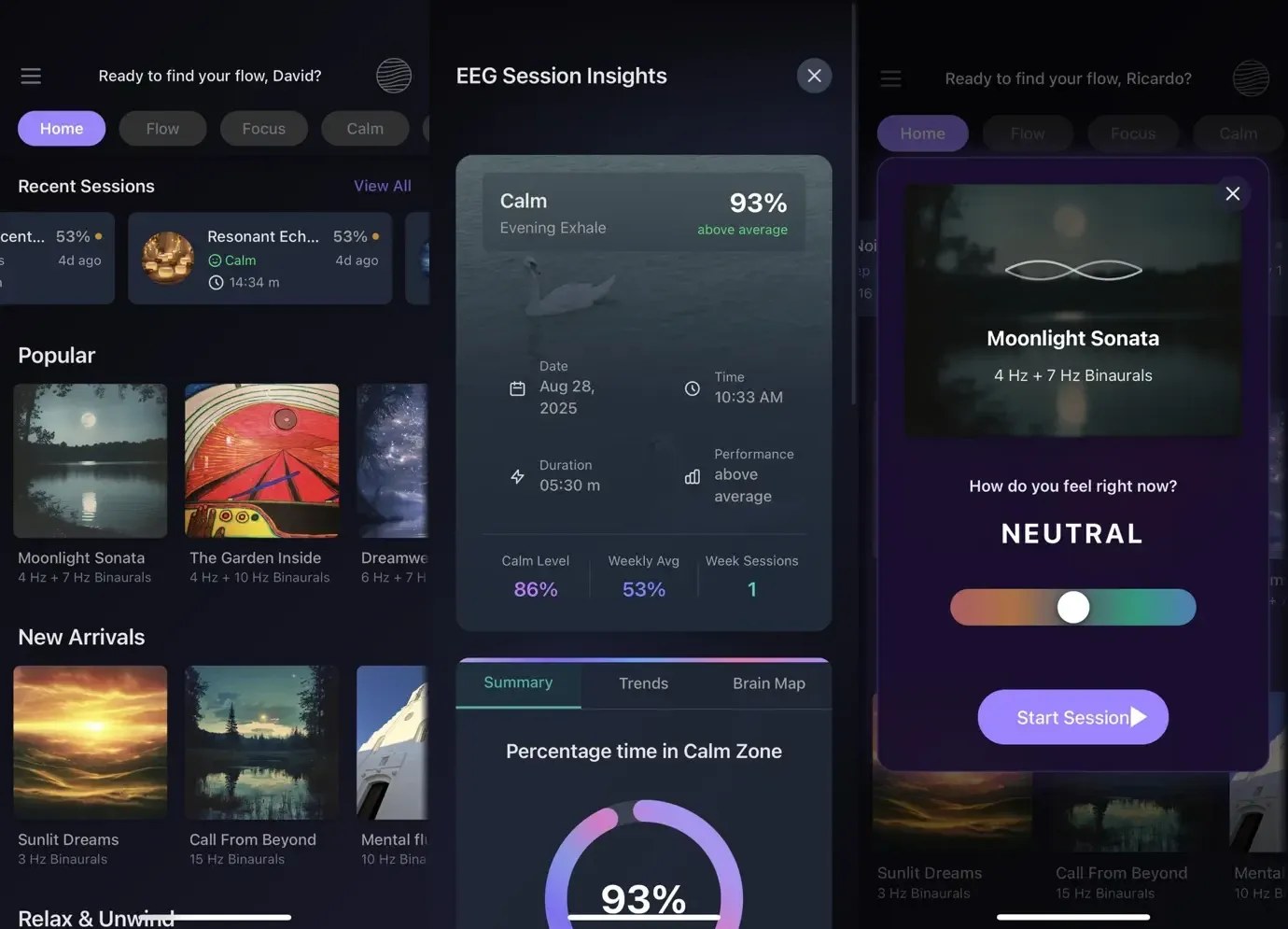
The eno app is free on iOS. You pick a mode (Focus, Flow, Energy, Calm, Wind Down or Sleep) and it plays adaptive tracks. Version 3.6 made binaural tracks respond to your brainwaves in real time, and a background mode lets it track while you use other apps.
What app users say:
- The US App Store rating is 2.9 from 22 ratings, the weakest of the three.
- The main complaint is the headphones not detecting EEG. One reviewer said it fails more than half the time, which breaks the whole point of brain-responsive music.
- Another said sessions never finished syncing to the server, so they couldn’t see any report.
- Several users say support never replied.
- On the plus side, people like the sound quality, and the team keeps shipping updates. It brought back the original tracks after user feedback.
My own view: the EEG reporting has lagged behind the music library. I’d buy Enophones for the audio experience and treat the data as a bonus.
3. Vital Neuro
Best for: people whose focus problems start with stress, anxiety or poor sleep, and who will commit to a daily training session.
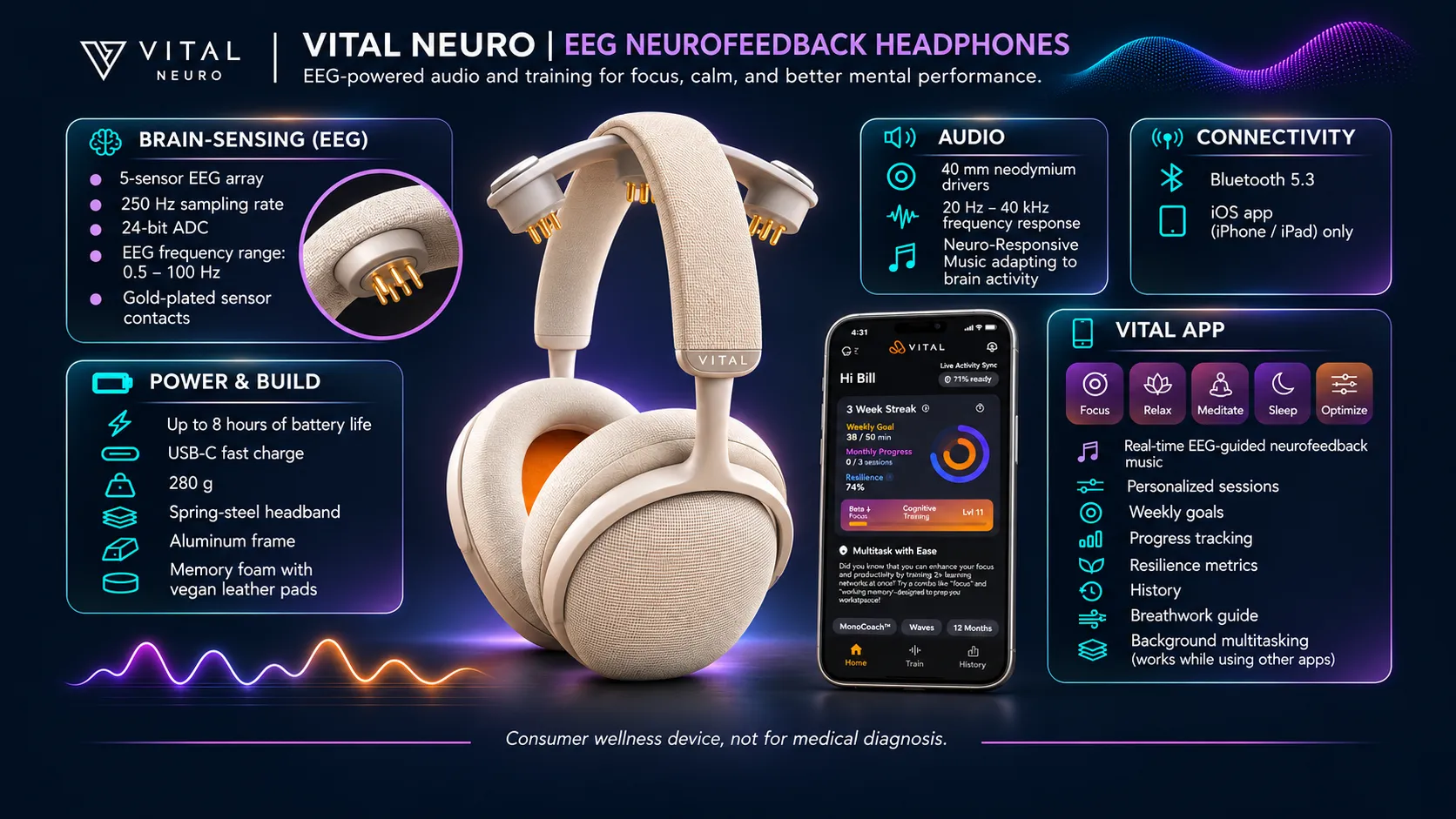
Vital Neuro grew out of clinical neurofeedback. The idea came from Dr. Kamran Fallahpour, a clinical psychologist in New York, who wanted to replace wired clinic setups with headphones. Co-founder Alex Doman works on the music side.
This is the most session-based of the three. You sit down, pick a goal and train for 5 to 30 minutes. A quick caveat, I haven’t tried these out for myself so I’m basing my assessment of these smart EEG headphones based on my research.
The headphones have three gold-plated EEG sensors, and some branch out to the front and back of the headband, so they reach more of the head than ear-pad sensors. Vital says they capture 250 data points per second. CEO John Golden explained that your phone sends the EEG to the cloud, which reads your brain state, composes music and streams it back to your headphones in real time. He argues that training specific brain regions needs sensors over those regions, not only at the forehead or ears.
The music’s tempo and frequency shift as your brain moves toward the goal, such as alpha for relaxation or beta for alertness. In a ReachMD interview, Golden said users see about a 45% drop in anxiety symptoms, a 45% gain in focus and a 30% gain in sleep, across groups like nurses, teachers and first responders. Treat those as company figures because it’s difficult and expensive to run a double-blind study as a startup.
Vital’s website says its study data reflect user-reported experiences, and I couldn’t find a named peer-reviewed trial behind them. Like the Enophones, people complain that the pins become uncomfortable with heavy use.
Pros
- Most clinical roots of the three
- Sensors reach beyond the ears, which suits real neurofeedback training
- Highest app rating and the most positive user reviews
- Breathwork, sleep and meditation in one app
- HSA/FSA eligible, with a 30-day money-back guarantee
Cons
- Most expensive over time: about $495 for the headphones, and the app subscription was listed at around $300 a year after the included first year
- Session-based, so it doesn’t track your normal workday
- Results claims are company-reported, not independently published
- Needs a cloud connection to compose the music
- iOS only as far as I can see
- Shorter battery (about 8 hours)
The Vital Neuro app
iPhone app: Vital Neuro (4.8/5 ⭐)
Android app: Not available
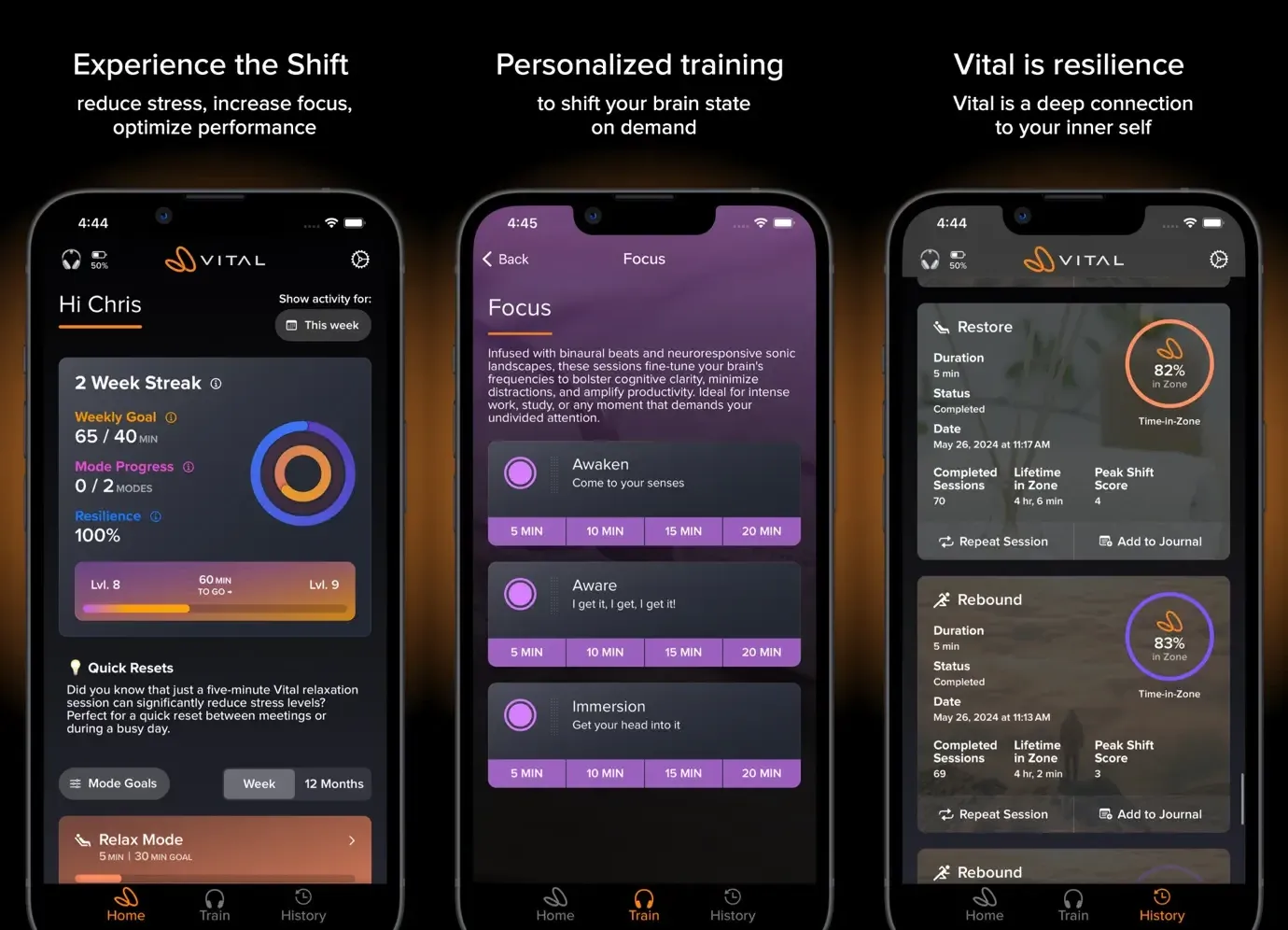
The Vital Neuro app has five session types: Relax, Focus, Optimize, Meditate and Sleep, in 5 to 30 minute blocks. Later updates added a breathwork guide, custom playlists, a session journal and history filters. It also tracks a Brain Vitality Index for focus and relaxation. I could only find the app on iOS.
What app users say:
- The US App Store rating is 4.8 from 44 ratings, the best of the three.
- Reviewers say they fall asleep faster, feel calmer and less reactive, and get a mood lift from 15 to 20 minute sessions.
- One user said a nightly Relax session replaced listening to podcasts to fall asleep.
- Most say the effects build over weeks.
- The criticism: one buyer said support was only a chatbot, and disliked having to watch a screen, which makes it hard to close your eyes to relax or sleep.
Which one should you pick for yourself?
Pick the Neurable One if you want to understand your workday. It’s the best tracker, the best everyday smart headphones for comfort and you want work and hack flow with the latest neurotech.
Pick Enophones if music is already your focus tool and you’re on a tighter budget. Go in knowing the app is the weak spot and the pins can be uncomfortable if you’re using it for a full day.
Pick Vital Neuro if stress and sleep are what wreck your focus, and you’ll actually sit down for daily sessions. The pins with these headphones can also become uncomfortable if you’re wearing them all day.
If I had to own just one as a founder, I’d take the Neurable One for the data, and keep meditation, breathwork and time in nature as my reset.
The future of flow: reclaiming our attention
The same technology that hacked our attention is starting to help us win it back.
For two decades, our phones and feeds were designed to pull focus away from what matters. Now a new wave of wearables can notice when our focus slips, nudge us back to the task and tell us to rest before we burn out. That’s the opposite of an attention trap.
The tech still has rough edges. Dry sensors are noisy, most of the research is run by the companies themselves and some apps lag behind their hardware. But it’s moving fast. Neurable went from a session-only tracker to passive, all-day brain tracking in about two years, and it’s now licensing its sensors for gaming headsets, helmets and hearing protection.
I think hacking the flow state is the future of focus and productivity. Tracking your brain will become as normal as tracking your steps or your sleep, and training your attention will be part of how founders and creators work.
As someone with ADHD juggling multiple businesses, I’m excited about where these devices are heading. My goal is simple: more hours of deep, meaningful work, and more energy left over for life outside it.

I believe the future of education starts with helping people find their "zone of genius" so they can develop their uniquely human ability to create meaning, connection and community (that A.I. can't replicate).
I'm also big on completely unplugging from tech to recharge on nature retreats and trekking adventures. That led me to start my most recent company Sacred Treks.
- Hack the Flow State With These 3 Smart EEG Headphones - November 10, 2026
- 10 Innovative New Biohacking Wearables I’m Excited For In 2027 - November 9, 2026
- Neurable One Review: Can These EEG Headphones Help You Reclaim Your Focus? - November 9, 2026